Author: zunair

  • Marketing Automation: The Complete Guide to Smarter Marketing in 2026

    Marketing Automation: The Complete Guide to Smarter Marketing in 2026

    Marketing is becoming more competitive, and businesses can no longer depend entirely on manual campaigns and repetitive follow-ups. In 2026, companies are increasingly using technology to create personalized experiences, nurture prospects, and improve marketing efficiency. Marketing automation makes this possible by using software and automated workflows to perform repetitive marketing tasks based on customer actions and predefined rules.

    Instead of sending every email manually or checking every lead individually, businesses can create systems that respond automatically when a customer visits a website, submits a form, downloads content, or interacts with a campaign. Salesforce describes automation as technology that manages marketing processes and campaigns across channels such as email, web, social, and text.

    What Is Marketing Automation?

    Marketing automation is the use of software to automate repetitive marketing activities while delivering relevant messages to customers at the right stage of their journey.

    For example, when someone signs up for a newsletter, an automated system can immediately send a welcome email. If that person later downloads an ebook, the system can send educational content and notify the sales team when the lead becomes highly engaged.

    This approach combines email marketing automation, lead nurturing, customer segmentation, and CRM automation into a connected process.

    The goal is not simply to send more messages. The goal is to deliver more relevant communication while allowing marketing teams to spend more time on strategy, creativity, and growth.

    How Does Marketing Automation Work?

    Most automated systems operate through triggers, conditions, and actions.

    A trigger starts the workflow. This could be a form submission, website visit, email interaction, purchase, or content download. The system then evaluates conditions and performs a specific action.

    For example:

    Website visitor → Form submission → Welcome email → Educational content → Lead scoring → Sales notification

    Modern workflow automation platforms can also update CRM records, assign leads, send notifications, and trigger follow-up activities automatically.

    This creates a smoother customer journey without requiring marketers to manually manage every interaction.

    Key Benefits of Marketing Automation

    1. Saves Time

    One of the biggest advantages is reducing repetitive work. Marketing teams can automate routine emails, lead assignments, follow-ups, audience segmentation, and campaign actions.

    Once a workflow has been properly configured, it can continue operating without someone manually starting every task.

    2. Improves Lead Nurturing

    Not every prospect is ready to buy immediately. Lead nurturing helps businesses build relationships by providing useful information over time.

    For example, a new prospect might receive educational content first, followed by a case study, product information, and eventually a sales invitation.

    HubSpot’s current guidance emphasizes that automation is particularly useful for delivering behavior-triggered content according to what a contact actually does rather than sending identical messages to everyone.

    3. Creates Personalized Customer Experiences

    Customers expect relevant communication. Automation allows businesses to segment audiences based on interests, behavior, location, purchase history, and engagement.

    A customer who repeatedly views a particular service page can receive content related to that service, while another customer can enter a completely different workflow.

    4. Helps Sales and Marketing Work Together

    CRM automation can connect marketing activity with sales processes. When a prospect reaches a specific engagement level, the system can update the CRM, assign the lead, or create a follow-up task.

    This reduces delays between marketing and sales and gives teams better visibility into customer activity.

    5. Measures Campaign Performance

    Automated systems can track important metrics such as email engagement, conversions, lead progression, campaign performance, and revenue-related outcomes.

    These insights help businesses identify which campaigns are working and where improvements are needed.

    Best Marketing Automation Strategies for 2026

    Businesses should focus on practical workflows rather than automating everything at once.

    Welcome sequences: Introduce new subscribers to your brand and guide them toward useful resources.

    Lead nurturing campaigns: Deliver educational content based on customer interests and engagement.

    Abandoned-cart reminders: Remind potential buyers about products they left behind.

    Re-engagement campaigns: Reach inactive subscribers with useful offers or content.

    Post-purchase workflows: Provide order information, product education, reviews, and future offers.

    Lead scoring: Prioritize prospects based on their interactions and level of interest.

    These automated marketing campaigns can help create consistent communication throughout the customer lifecycle.

    How to Choose Marketing Automation Software

    Choosing the right platform depends on business size, marketing goals, budget, integrations, and technical requirements.

    Look for features such as:

    • Email campaign automation
    • CRM integration
    • Lead scoring
    • Audience segmentation
    • Landing page and form integration
    • Analytics and reporting
    • Workflow builders
    • Customer journey automation
    • Third-party integrations
    • AI-assisted workflow creation

    Popular platforms include HubSpot, Salesforce, Active Campaign, and other specialized marketing technology providers. The best choice is not necessarily the platform with the largest feature list. It is the one that fits your existing processes and can scale with your business.
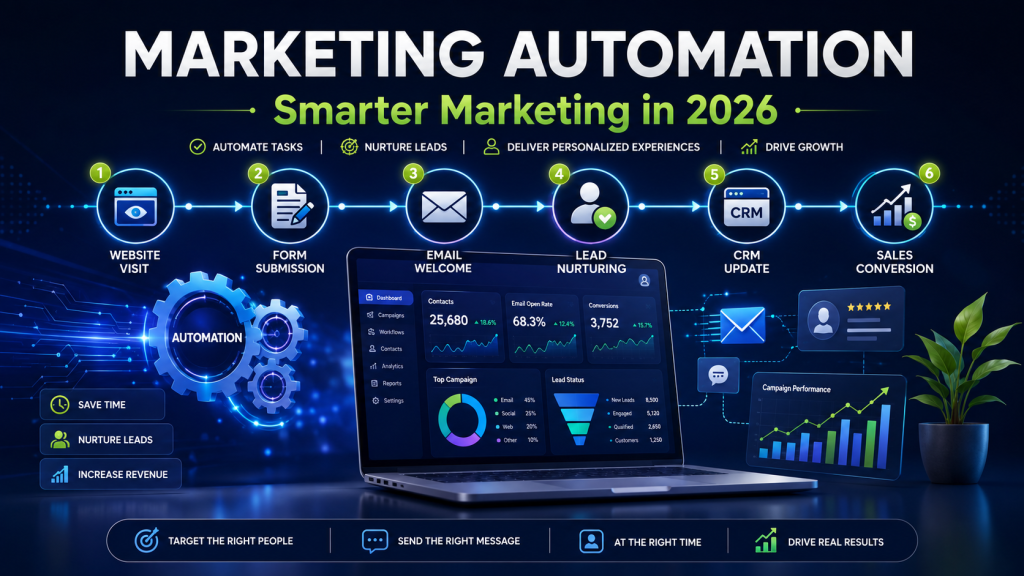
    Marketing automation featured image showing a digital workflow from website visit and form submission to email, lead nurturing, CRM updates, and sales conversion, with an automation dashboard, analytics charts, and marketing technology graphics.

    Common Mistakes to Avoid

    Automation can create problems when workflows are poorly planned. Sending too many messages can frustrate subscribers, while incorrect segmentation can deliver irrelevant content.

    Businesses should also avoid creating complicated workflows before understanding their customer journey.

    Start with simple processes, test each workflow, monitor performance, and improve campaigns based on real customer behavior. Automation should support human strategy rather than completely replace it.

    Is Marketing Automation Worth It in 2026?

    Yes, when implemented strategically. Modern businesses need to communicate quickly while maintaining personalization and consistency. Automation helps teams manage growing audiences without increasing manual workload at the same rate.

    The strongest strategy combines automation with high-quality content, accurate customer data, thoughtful segmentation, and human creativity.

    Final Thoughts

    Marketing automation is no longer just an advanced feature for large companies. It has become an important part of modern digital marketing because businesses of different sizes can use automated workflows to save time, nurture leads, personalize communication, and improve campaign performance.

    The key is to automate repetitive tasks while keeping the customer experience human. Start with one valuable workflow, measure the results, and gradually expand your automation strategy. With the right approach, automation can become a powerful foundation for sustainable marketing growth in 2026.
  • AI SEO Tools: The Best Ways to Improve Search Rankings in 2026

    AI SEO Tools: The Best Ways to Improve Search Rankings in 2026

    Search engine optimization is changing rapidly in 2026. Search engines are becoming better at understanding search intent, content quality, context, and user experience. At the same time, artificial intelligence is helping marketers research keywords, optimize content, analyze competitors, identify technical issues, and build smarter SEO strategies.

    For businesses, bloggers, agencies, and content creators, AI SEO Tools can make the optimization process faster and more efficient. However, the best results come from combining AI-powered workflows with human expertise, original insights, and useful content.

    Google’s current guidance makes an important point: AI can assist with content creation and research, but websites still need accurate, original, high-quality, people-first content. Automatically producing large amounts of low-value pages simply to manipulate rankings can violate Google’s spam policies.

    What Are AI SEO Tools?

    AI SEO Tools are software solutions that use artificial intelligence and machine learning to simplify different parts of search engine optimization. Instead of manually analyzing hundreds of keywords, pages, competitors, or content opportunities, marketers can use AI to identify patterns and generate useful recommendations.

    Depending on the platform, an AI-powered SEO workflow can help with:

    • Keyword research
    • Search intent analysis
    • Content optimization
    • Competitor research
    • Content briefs
    • On-page SEO
    • Technical SEO analysis
    • Internal linking
    • SERP analysis
    • Content gap research
    • SEO reporting

    The biggest advantage is efficiency. Tasks that previously required hours of manual research can often be completed much faster with the right workflow.

    Why AI SEO Tools Matter in 2026

    Search is no longer limited to traditional blue-link results. Google’s generative AI features are changing how people discover and consume information.

    In May 2026, Google published a dedicated guide explaining how website owners can optimize for generative AI features in Search. Google emphasized that established SEO fundamentals remain important and that websites should focus on valuable, unique content rather than creating large volumes of pages for search manipulation.

    This means your strategy should not simply be about adding more keywords. Your content needs to answer questions clearly, demonstrate expertise, provide useful information, and satisfy the visitor.

    1. Use AI for Smarter Keyword Research

    AI Keyword research tools remains one of the foundations of SEO. AI can help you move beyond simple keyword lists by organizing queries according to search intent.

    For example, instead of targeting only a broad phrase such as “digital marketing,” you can identify related searches around:

    • Digital marketing strategies
    • Digital marketing for small businesses
    • Online marketing ideas
    • Content marketing strategies
    • Search engine optimization tips
    • Local search optimization

    This approach helps create topic clusters and gives your website broader topical coverage.

    The goal should not be to insert every keyword into one article. Instead, choose terms that genuinely support the reader’s search journey.

    2. Improve Content Optimization

    One of the strongest uses of AI SEO Tools is content analysis. Modern SEO software can evaluate headings, keyword coverage, topic relevance, readability, and content structure.

    You can use these insights to identify missing subtopics and improve an existing article.

    However, optimization should never make content sound robotic. Google states that its systems aim to reward helpful, reliable information created primarily for people.

    A better workflow is simple: let AI identify opportunities, then use human judgment to add examples, experience, opinions, original research, and useful explanations.

    3. Analyze Competitors More Efficiently

    Competitor analysis can reveal why certain pages are performing well.

    AI-powered SEO platforms can help you examine competing content and identify patterns such as:

    • Topics they cover
    • Keywords they target
    • Questions they answer
    • Content formats they use
    • Potential content gaps
    • Pages that attract search visibility

    But copying competitors is not a winning strategy.

    Instead, use competitor analysis to discover what users expect and then create something more useful, specific, and original.

    4. Find Content Gaps

    A content gap exists when your website does not adequately address a topic that your audience is searching for.

    AI SEO Tools can help compare your existing content with competing pages and organize potential opportunities.

    For example, if you have an article about “SEO for small businesses,” an analysis might reveal related topics such as local SEO, Google Business Profile optimization, technical SEO, link building, content strategy, and conversion optimization.

    These opportunities can become new articles or sections within existing pages.

    5. Support Technical SEO

    Technical SEO is another area where automation can save significant time.

    AI-assisted workflows can help SEO professionals identify potential problems involving:

    • Broken links
    • Missing metadata
    • Duplicate content
    • Indexing problems
    • Poor page structure
    • Internal linking opportunities
    • Page experience issues

    AI should be treated as an assistant rather than an unquestionable authority. Important technical recommendations should be reviewed before making major website changes.

    6. Optimize for AI Search and Traditional Search

    The rise of AI-powered search does not mean traditional SEO is dead.

    Google’s 2026 guidance specifically reinforces the importance of fundamental SEO practices while discussing optimization for generative AI features.

    That makes a combined strategy more practical:

    Traditional SEO + Helpful Content + Strong Technical Foundations + AI Search Optimization

    Create content that is easy for people to understand and easy for search systems to interpret. Use descriptive headings, clear answers, relevant supporting information, internal links, useful media, and accurate structured data where appropriate.

    How to Choose the Right AI SEO Tool

    Don’t choose a platform simply because it has the most AI SEO Tools features. Start with your actual SEO goals.

    Consider:

    1. Keyword research: Does it provide useful keyword and intent insights?
    2. Content optimization: Can it identify meaningful topical improvements?
    3. Technical SEO: Does it help discover important website problems?
    4. Competitor analysis: Can you understand competitive opportunities?
    5. Reporting: Can you measure progress clearly?
    6. Ease of use: Can your team actually use it consistently?
    7. Human control: Can recommendations be reviewed instead of automatically published?

    The best AI SEO Tools is the one that improves your workflow without replacing strategic thinking.

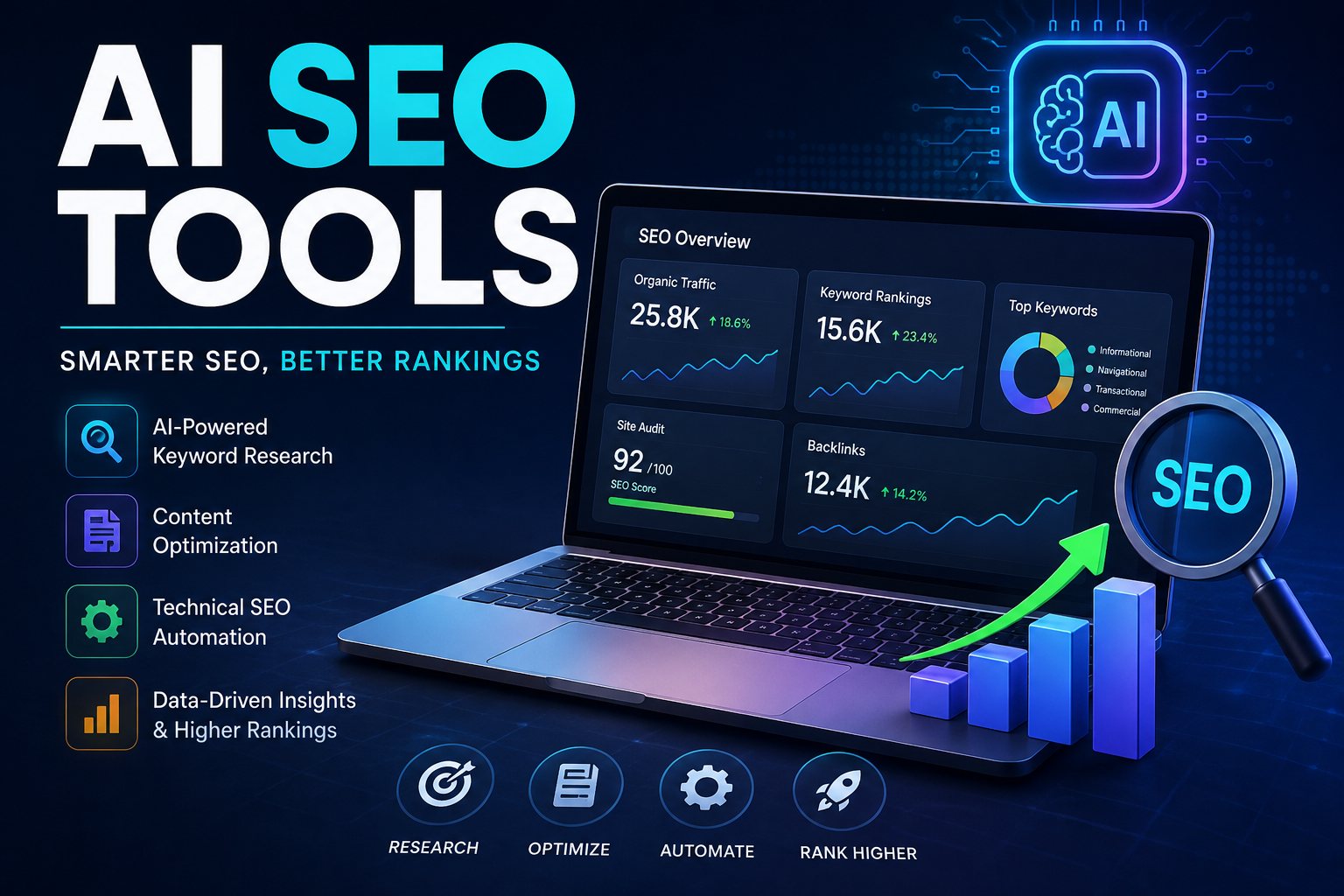
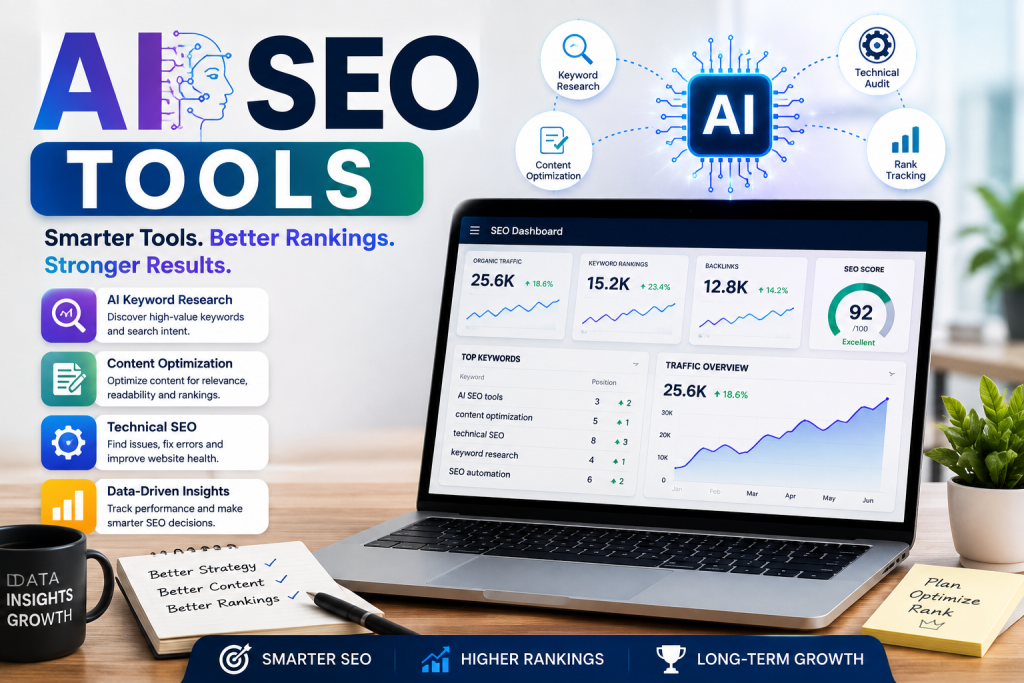
    AI SEO tools dashboard showing keyword research, content optimization, technical SEO, rank tracking, and SEO performance insights for better search rankings.

    Common Mistakes to Avoid

    AI can make SEO faster, but using it incorrectly can create problems.

    Avoid publishing large amounts of generic AI-generated content, stuffing keywords unnaturally, copying competitor structures too closely, or creating pages solely to capture search variations.

    Google’s guidance warns that generating many pages with AI without adding value can fall under scaled content abuse.

    Instead, use AI for research, organization, analysis, brainstorming, and optimization—then add genuine human value.

    Final Thoughts

    The best AI SEO Tools are not replacements for SEO professionals. They are productivity tools that can help marketers research faster, identify opportunities, improve content, and make better decisions.

    In 2026, the winning strategy is not simply “use more AI.” It is to use AI intelligently while maintaining strong SEO fundamentals, original expertise, accuracy, and a people-first approach.

    If you combine intelligent automation with high-quality content and a clear understanding of search intent, you can build a stronger, more scalable SEO strategy for long-term organic visibility.

  • Copywriting Tips: 15 Proven Ways to Write Persuasive Content That Converts in 2026

    Copywriting Tips: 15 Proven Ways to Write Persuasive Content That Converts in 2026

    Great copywriting is not about using complicated words or sounding clever. It is about understanding what readers want, addressing their problems, and giving them a clear reason to take action. Whether you are writing website pages, product descriptions, emails, advertisements, or social media content, strong copy can turn attention into clicks, leads, and sales.

    In 2026, competition for online attention is higher than ever. That makes persuasive writing, clear messaging, and customer-focused content essential for businesses and creators. The following copywriting tips can help you create content that is easier to read, more engaging, and more effective.

    1. Know Your Target Audience

    Before writing a single sentence, understand who you are speaking to. Identify your audience’s needs, goals, frustrations, objections, and buying motivations.

    Instead of writing generic content, use language that reflects the real problems your readers experience. For example, a marketing agency should focus on business growth, qualified leads, visibility, and return on investment rather than simply describing its services.

    Audience research is one of the most important foundations of effective copywriting tips.

    2. Start With a Powerful Headline

    Copywriting techniques:

    Your headline determines whether many people will continue reading. A strong headline should communicate a benefit, create curiosity, or address a specific problem.

    Compare:

    Weak:
    “Digital Marketing Services”

    Stronger:
    “Turn More Website Visitors Into Paying Customers With Smarter Digital Marketing”

    The second headline gives readers a clear reason to continue.

    Use your primary keyword naturally when it fits, but never sacrifice clarity just to include a keyword.

    3. Focus on Benefits, Not Just Features

    One of the most valuable copywriting tips is learning the difference between features and benefits.

    A feature tells people what something has. A benefit explains why they should care.

    For example:

    Feature: “Our software provides automated reporting.”

    Benefit: “Save hours every week with reports that generate automatically.”

    Benefits connect directly with the reader’s desired outcome. When creating sales copy, explain how your product or service can make life easier, save time, reduce costs, or solve a specific problem.

    4. Use Simple and Conversational Language

    Readers do not want to decode complicated sentences. Write the way a knowledgeable person would naturally explain something to another person.

    Avoid unnecessary jargon, long introductions, and overly complex vocabulary. Keep paragraphs short and make your sentences easy to scan.

    Simple writing does not mean boring writing. It means removing anything that makes the message harder to understand.

    5. Create a Strong Value Proposition

    Your value proposition should quickly answer three questions:

    • What do you offer?
    • Who is it for?
    • Why should someone choose you?

    A strong value proposition separates your business from competitors and communicates your unique advantage.

    For example, instead of saying “We provide SEO services,” you could say, “We help growing businesses improve search visibility and attract more qualified organic traffic.”

    Specificity makes your message more convincing.

    6. Use Storytelling to Build Connection

    People remember stories more easily than lists of facts. Storytelling can make brand messaging more relatable and emotionally engaging.

    You can describe a customer’s problem, explain the challenge they faced, and show how the solution produced a positive outcome.

    A simple structure is:

    Problem → Struggle → Solution → Result

    This approach works particularly well for landing pages, case studies, email marketing, and brand storytelling.

    7. Write for Scanners

    Most online readers scan before they decide to read deeply. Make your content easy to navigate.

    Use:

    • Short paragraphs
    • Descriptive headings
    • Bullet points
    • Bold emphasis where appropriate
    • Clear transitions
    • Plenty of white space

    This improves readability and helps visitors quickly locate the information they need.

    8. Use Persuasive Words Carefully

    Persuasive writing does not require aggressive sales language. Instead, choose words that communicate value, confidence, and relevance.

    Words such as proven, practical, reliable, simple, powerful, flexible, affordable, effective, and results-driven can strengthen messaging when they accurately describe your offer.

    Avoid exaggerated claims that you cannot support. Trust is more valuable than hype.

    9. Address Customer Objections

    Potential customers often have questions before taking action.

    They may wonder:

    • Is this worth the price?
    • Will it work for my situation?
    • How difficult is it to use?
    • Can I trust this company?
    • What happens if I need help?

    Address these concerns directly in your copy. Adding testimonials, guarantees, demonstrations, FAQs, reviews, or evidence can reduce uncertainty and increase conversions.

    10. Add a Clear Call to Action

    Every piece of marketing copy should have a purpose. Your call to action tells readers what to do next.

    Instead of generic phrases like “Click Here,” use action-oriented language such as:

    Get Your Free Quote
    Start Your Free Trial
    Book a Consultation
    Download the Guide
    Learn More

    A clear CTA removes confusion and makes the next step obvious.

    11. Optimize Content for Search Intent

    SEO copywriting is not simply about repeating keywords. Search engines increasingly prioritize useful content writing tips that satisfies the reason behind a search.

    If someone searches for “best email marketing software,” they probably want comparisons, features, pricing information, and recommendations.

    Understand the search intent first, then create content that answers the user’s actual question.

    Use your primary keyword naturally in strategic locations such as the title, introduction, headings, URL, and relevant sections. Avoid keyword stuffing because unnatural repetition can damage readability and user experience.

    12. Build Trust With Specific Evidence

    Specific information is usually more persuasive than vague promises.

    Instead of saying:

    “We deliver amazing results.”

    Say:

    “Our campaign generated 42% more qualified leads within three months.”

    Whenever possible, support claims with data, testimonials, case studies, customer experiences, certifications, or recognizable proof.

    Credibility can make the difference between a visitor leaving and becoming a customer.

    13. Edit Ruthlessly

    Your first draft is rarely your best draft. Strong writers improve their work through editing.

    After finishing, remove unnecessary words, repeated ideas, weak openings, and confusing sentences. Look for places where you can make the message shorter and clearer.

    Read the copy aloud. If a sentence sounds unnatural when spoken, rewrite it.

    A useful editing question is:

    “Does this sentence help the reader?”

    If it does not, consider removing it.

    14. Test Different Versions

    There is no universal formula for perfect marketing copy. What works for one business may not work for another.

    Test different:

    • Headlines
    • CTAs
    • Offers
    • Opening sentences
    • Benefits
    • Page layouts
    • Email subject lines

    A/B testing can reveal which messages generate better engagement and conversions. Use actual performance data rather than relying only on assumptions.

    15. Keep Improving Your Copywriting Skills

    The best writers continuously study customer behavior, advertising, psychology, SEO, and communication.

    Read successful landing pages. Analyze advertisements. Study high-performing email campaigns. Pay attention to the words customers use when describing their problems.

    Most importantly, practice regularly.

    Copywriting tips infographic showing persuasive writing strategies, clear copy, audience research, powerful words, and conversion-focused content in 2026.

    Final Thoughts

    Effective copywriting combines psychology, clarity, research, storytelling, and strategy. The goal is not simply to produce attractive sentences—it is to communicate value and motivate the reader to take the next step.

    These copywriting tips can help you create stronger website content, landing pages, emails, advertisements, product descriptions, and social media messages throughout 2026.

    Remember the core principle: write for people first, then optimize for search. When your content genuinely answers questions, solves problems, builds trust, and communicates benefits clearly, it has a much better chance of attracting attention and converting readers into customers.

  • Content Marketing: The Complete Guide to Growing Your Business in 2026

    Content Marketing: The Complete Guide to Growing Your Business in 2026

    In 2026, businesses need more than advertisements to attract customers and build long-term trust. People search for information, compare solutions, read reviews, watch videos, and explore brands before making purchasing decisions. This is where Content Marketing becomes one of the most effective ways to attract, educate, and convert potential customers.

    A strong strategy helps businesses create useful content that answers real questions while building credibility with their audience. Whether you run a small business, online store, SaaS company, personal brand, or professional service, the right approach can increase organic traffic, leads, and customer loyalty.

    What Is Content Marketing?

    Content Marketing is the process of creating and distributing valuable, relevant, and consistent content to attract a specific audience. Instead of directly pushing a product or service in every message, businesses provide information that helps people solve problems and make better decisions.

    Common forms of content include:

    • Blog posts and SEO articles
    • Videos and tutorials
    • Social media content
    • Case studies
    • Email newsletters
    • Infographics
    • Ebooks and guides
    • Podcasts
    • Product comparisons

    The goal is simple: provide value first and build trust over time.

    Why Content Marketing Matters in 2026

    Search behavior continues to change. People now discover brands through traditional search engines, social platforms, video platforms, AI-powered search experiences, and online communities.

    High-quality content gives your business more opportunities to appear during these discovery moments.

    A well-planned strategy can help you:

    • Increase organic search visibility
    • Generate qualified website traffic
    • Build brand awareness
    • Establish industry authority
    • Improve audience engagement
    • Generate leads
    • Support sales
    • Strengthen customer relationships

    Instead of depending entirely on paid advertising, businesses can build an asset library that continues attracting visitors long after content is published.

    How to Create a Successful Content Marketing Strategy

    A successful content marketing strategy starts with research rather than random posting. Before creating content, understand who you want to reach, what they search for, and what problems they are trying to solve.

    1. Define Your Target Audience

    Start by identifying your ideal customer. Consider their interests, challenges, goals, buying behavior, and common questions.

    The more clearly you understand your audience, the easier it becomes to create useful content that feels relevant.

    2. Research Relevant Keywords

    Keyword research is an important part of an effective content strategy. Find keywords that match your products, services, and audience’s search intent.

    Focus on a combination of:

    • Primary keywords
    • Long-tail keywords
    • Question-based searches
    • Commercial keywords
    • Informational keywords
    • Related semantic terms

    Avoid forcing keywords into every paragraph. Search engines increasingly prioritize helpful, relevant, and easy-to-understand information.

    3. Create Helpful, Original Content

    Quality matters more than publishing hundreds of weak articles. Your content creation process should focus on solving problems better than competing pages.

    For example, instead of writing a generic article about email marketing, create a practical guide with examples, actionable steps, common mistakes, and useful tips.

    Original insights, firsthand experience, examples, statistics, and expert perspectives can make your content more valuable.

    4. Optimize Content for SEO

    SEO content should be written for humans first and search engines second.

    Optimize important elements such as:

    • SEO title
    • Meta description
    • URL slug
    • Headings
    • Introduction
    • Image alt text
    • Internal links
    • External references
    • Keyword placement

    Use your primary keyword naturally while including relevant secondary keywords throughout the article.

    Content Distribution Is Just as Important

    Creating great content is only half the job. Content distribution helps your work reach more people.

    After publishing an article, consider sharing it through:

    • Social media
    • Email marketing
    • Online communities
    • Business profiles
    • Video content
    • Newsletters
    • Industry websites

    You can also repurpose one strong article into multiple formats. A detailed blog post could become a short video, social media posts, an infographic, an email, and several short-form content pieces.

    This approach saves time while expanding your reach.

    Measure Your Content Marketing Performance

    A professional content marketing plan should include measurable goals. Publishing content without tracking results makes it difficult to know what is working.

    Important metrics include:

    • Organic traffic
    • Search rankings
    • Click-through rate
    • Engagement
    • Time on page
    • Leads generated
    • Conversion rate
    • Returning visitors
    • Social shares

    Do not focus only on traffic. A smaller amount of highly relevant traffic can be more valuable than thousands of visitors who have no interest in your products or services.

    Content marketing strategy guide for business growth in 2026

    Common Content Marketing Mistakes to Avoid

    Many businesses struggle because they focus on quantity instead of quality. Common mistakes include publishing without keyword research, targeting the wrong audience, copying competitors, ignoring search intent, using excessive keywords, and failing to update old content.

    Another mistake is expecting immediate results. Organic growth usually requires consistency. A strong strategy becomes more powerful as your website builds authority and develops a larger library of useful resources.

    Final Thoughts

    Content Marketing is no longer simply about publishing blog posts. In 2026, it is a complete growth strategy that combines SEO content, content creation, audience engagement, digital marketing, and content distribution.

    Businesses that consistently answer customer questions, provide genuine value, and create content around real search intent can build stronger visibility and trust.

    The best approach is not to publish more content just for the sake of publishing. Instead, create useful, original, search-friendly content that helps your audience at every stage of the buying journey. With a clear strategy and consistent execution, content can become one of your most valuable long-term digital marketing assets.

  • Pinterest SEO: The Complete Guide to Ranking Pins and Growing Traffic in 2026

    Pinterest SEO: The Complete Guide to Ranking Pins and Growing Traffic in 2026

    Pinterest is no longer just a platform for saving recipes, fashion ideas, and home inspiration. It has become a powerful visual search engine where people actively discover ideas, products, brands, and solutions. For businesses, bloggers, creators, and online stores, learning Pinterest SEO can turn Pinterest searches into consistent website traffic, leads, and sales.

    Unlike traditional social media platforms where content can disappear quickly, Pinterest content can remain discoverable long after publication. Pinterest itself describes the platform as a place where people search, save, and shop ideas, making search visibility especially valuable for marketers.

    What Is Pinterest SEO?

    Pinterest SEO is the process of optimizing your Pinterest profile, boards, Pins, images, titles, descriptions, and links so your content has a better chance of appearing in relevant Pinterest searches.

    The goal is simple: match your content with what people are searching for.

    Pinterest uses both keyword and visual search to help people discover content. Related Pins can also expose users to content similar to what they are already viewing.

    That means your strategy should focus on two things:

    • Creating content people actually want
    • Clearly communicating what your content is about

    Why Pinterest SEO Matters in 2026

    Pinterest SEO remains particularly valuable for pinterest businesses because users often arrive with an intention to discover, plan, compare, or purchase. Pinterest reports that it reaches 631 million monthly active users globally, while its audience includes substantial numbers of adults across different age groups.

    Search behavior is another major advantage. Pinterest says people use the platform like a search engine, starting with broad ideas and narrowing their searches toward specific plans or products.

    For marketers, this creates an opportunity to attract people before they make a purchasing decision.

    1. Start With Pinterest Keyword Research

    Strong keyword research should be the foundation of your strategy.

    Think about the exact phrases your ideal audience might type into Pinterest SEO. Instead of targeting only broad terms, build a combination of:

    • Primary keywords
    • Long-tail keywords
    • Related search terms
    • Product-specific keywords
    • Problem-based keywords
    • Seasonal keywords

    For example, a home decor brand might target phrases such as:

    Primary keyword: home decor ideas

    Secondary keywords: living room decor, small apartment decor, modern home ideas, bedroom decorating ideas, budget-friendly decor

    Long-tail keywords can be especially useful because they describe a more specific search intent.

    2. Optimize Your Pinterest Profile

    Your profile should immediately tell Pinterest and potential visitors what your business or content is about.

    Use relevant keywords naturally in your:

    • Profile name
    • Bio
    • Board names
    • Board descriptions
    • Website information

    Avoid stuffing keywords into every sentence. Instead, create a clear profile that explains what people can expect from your content.

    A profile focused on digital marketing, for example, could naturally mention SEO tips, social media marketing, content marketing, and online business strategies.

    3. Create Search-Friendly Boards

    Boards aren’t simply folders for your Pins. They can also appear in search results.

    Pinterest boards recommends giving boards clear, descriptive titles because people can discover boards through search.

    Instead of creating a board called “My Ideas,” use a descriptive title such as:

    SEO Tips for Small Businesses

    Then write a useful board description containing closely related terms.

    Create separate boards around specific topics rather than putting every Pin into one general board.

    4. Optimize Pin Titles and Descriptions

    Pinterest search optimization your Pin title is one of the most important places to communicate relevance.

    Make the title descriptive, compelling, and easy to understand.

    For example:

    Weak:
    Amazing Tips You Need to Know

    Better:
    10 Pinterest SEO Tips to Increase Your Website Traffic

    Your description should provide additional context instead of simply repeating the title.

    Include relevant secondary keywords naturally and explain what the user will discover after clicking.

    Pinterest specifically recommends using relevant keywords in Pin titles and descriptions to help contextualize content.

    5. Design Eye-Catching Pinterest Pins

    Keywords alone won’t make a weak Pin successful.

    Pinterest is a visual discovery platform, so your creative needs to immediately communicate value. Pinterest recommends using eye-catching images, videos, text overlays, and other creative elements to make Pins stand out.

    A strong Pin should generally have:

    • A clear headline
    • Easy-to-read typography
    • Strong visual hierarchy
    • A relevant image
    • A specific benefit
    • Consistent branding
    • A clear reason to click

    Don’t overload your graphic with paragraphs of text. Make the main promise understandable within seconds.

    6. Use Relevant Topics and Keywords

    When Pinterest gives you the option to add topics, use them.

    Topics help provide additional context about your content and can help Pinterest understand which audiences may find your Pin relevant. Pinterest recommends adding topics whenever the option is available.

    Think beyond your primary keyword. Include closely related concepts that accurately describe your content.

    For example, a Pin about healthy breakfast recipes could relate to:

    • Easy breakfast recipes
    • Healthy meal ideas
    • Quick breakfast
    • Meal prep
    • Family recipes

    Relevance is more important than simply adding as many keywords as possible.

    7. Link Pins to Valuable Landing Pages

    Pinterest can generate traffic, but your website needs to deliver the value promised by the Pin.

    Every relevant Pin should point to a useful destination, such as:

    • Blog articles
    • Product pages
    • Service pages
    • Landing pages
    • Tutorials
    • Lead magnets
    • Online stores

    Pinterest recommends adding URLs to Pins so they can drive visitors back to your website.

    Make sure the destination page matches the Pin. If your Pin promises “10 Small Bedroom Decorating Ideas,” the link should take users directly to that content rather than an unrelated homepage.

    8. Publish Consistently

    Consistency matters more than publishing a huge number of Pins for a few days and then disappearing.

    Pinterest recommends creating new original Pins regularly, with its business guidance suggesting at least one new original Pin per week as a steady publishing approach.

    Build a realistic content calendar around your available resources.

    You can create multiple pieces of content around one topic by changing:

    • Headlines
    • Images
    • Layouts
    • Angles
    • Keywords
    • Calls to action

    However, always prioritize genuinely useful and original content.

    9. Use Pinterest Trends for Content Ideas

    Pinterest Trends can help you discover topics people are increasingly interested in.

    Pinterest Predicts 2026 identifies emerging trends using billions of search and engagement data points, combined with predictive analytics and expert analysis.

    You can use trend insights to develop timely content around:

    • Seasonal searches
    • Emerging aesthetics
    • Shopping trends
    • Lifestyle topics
    • Popular styles
    • New consumer interests

    The key is to connect trends with your niche rather than chasing every popular topic.

    10. Measure Your Results

    Don’t judge your strategy only by followers.

    Track metrics that connect Pinterest activity with business outcomes, including:

    • Impressions
    • Saves
    • Pin clicks
    • Outbound clicks
    • Engagement
    • Website traffic
    • Leads
    • Sales

    Pinterest Business provides analytics and audience insights to help businesses understand content performance and audience behavior.

    Use these insights to identify which topics, designs, keywords, and content formats generate the strongest results.

    Pinterest SEO 2026 guide featuring keyword research, optimized Pins, smart boards, increased visibility, and website traffic growth.

    Common Pinterest SEO Mistakes to Avoid

    Several mistakes can limit your visibility.

    Avoid:

    • Keyword stuffing
    • Generic board names
    • Weak Pin titles
    • Poor-quality graphics
    • Irrelevant hashtags or keywords
    • Sending users to unrelated pages
    • Publishing duplicate content without meaningful variation
    • Ignoring analytics
    • Inconsistent publishing
    • Focusing only on followers

    The best strategy is not about manipulating the platform. It is about making your content easier to understand and more useful to the people searching for it.

    Final Thoughts

    A successful Pinterest SEO strategy combines keyword research, optimized boards, compelling Pin titles, useful descriptions, strong visuals, relevant topics, consistent publishing, and valuable website content.

    The biggest opportunity in 2026 is to think of Pinterest less like a traditional social network and more like a visual search and discovery engine. When you understand what people search for and create content that genuinely answers those searches, your Pins can continue attracting attention, clicks, and customers long after they are published.

    Start with a focused niche, build keyword-rich but natural boards, create highly useful Pins, connect them to relevant pages, and continuously improve your strategy using Pinterest analytics. With consistency and strong search intent, Pinterest can become a reliable source of organic traffic and business growth.

  • YouTube SEO: A Complete Guide to Ranking Videos Higher in 2026

    YouTube SEO: A Complete Guide to Ranking Videos Higher in 2026

    Creating a great video is only half the battle. If people cannot find it, even excellent content can struggle to generate views, subscribers, and leads. That is where YouTube SEO becomes important.

    In 2026, successful creators need more than keywords. YouTube SEO considers relevance, engagement, quality, viewer behavior, and personalization when determining which videos appear in search and recommendations.

    This guide explains how to optimize your videos, titles, descriptions, thumbnails, and overall channel strategy so your content has a better opportunity to reach the right viewers.

    What Is YouTube SEO?

    YouTube SEO is the process of optimizing videos and channels so they can be discovered more easily through YouTube search and recommendations.

    The goal is not simply to add as many keywords as possible. Instead, you should clearly communicate what your video is about while creating content that viewers actually want to watch.

    YouTube says its search system primarily considers relevance, engagement, and quality. Relevance can include how closely the title, description, tags, and video content match a search query.

    That means your optimization strategy should combine keyword research with useful, engaging content.

    1. Start With YouTube Keyword Research

    Before recording a video, identify what your potential viewers are searching for.

    Instead of choosing a broad topic such as “social media,” consider specific search phrases like:

    • social media marketing for beginners
    • how to grow a YouTube channel
    • best video editing apps
    • how to create YouTube thumbnails
    • YouTube marketing tips for small businesses

    Long-tail keywords can help you target more specific search intent and create content around questions people actually ask.

    YouTube’s own guidance recommends using its Analytics Research tools and keyword research resources to discover popular terms and related phrases.

    2. Create Search-Friendly Video Titles

    Your title is one of the first things viewers see. It also helps communicate the subject of your video.

    A strong title should be:

    • Clear and specific
    • Relevant to the actual video
    • Easy to understand
    • Naturally connected to the target keyword
    • Interesting enough to encourage clicks

    For example, instead of writing:

    “My New Strategy”

    try:

    “YouTube SEO Strategy: 7 Ways to Get More Views in 2026”

    The second title immediately tells viewers what they can expect.

    YouTube SEO recommends keeping titles concise, placing important words near the beginning, and making sure the title accurately represents the video.

    3. Optimize Your Video Description

    A well-written video description gives viewers and YouTube additional context about your content.

    Place the most important information near the beginning because those opening lines are visible before viewers expand the description. YouTube SEO recommends creating unique descriptions and naturally including one or two primary terms that describe the video.

    For example, your description can briefly explain:

    • What the video teaches
    • Who should watch it
    • The main topics covered
    • Useful resources
    • Related videos or playlists
    • A simple call to action

    Avoid filling your description with repetitive keywords. Write for humans first.

    4. Design Better YouTube Thumbnails

    A thumbnail does not directly function like a traditional keyword field, but it can have a major impact on whether someone chooses to watch.

    Your thumbnail should communicate the video’s value quickly.

    Use:

    • One clear visual idea
    • Readable text
    • Strong contrast
    • Consistent branding
    • A simple composition
    • An image that supports the title

    YouTube reports that 90% of its best-performing videos have custom thumbnails and recommends testing different thumbnail approaches to improve appeal.

    The title and thumbnail should work together rather than repeat exactly the same information.

    5. Improve Watch Time and Audience Retention

    Getting a click is not enough. Your video must deliver on the promise made by the title and thumbnail.

    Start with a strong hook. Tell viewers what they will learn or gain, then get into the valuable content quickly.

    Avoid unnecessarily long introductions, excessive filler, or unrelated information.

    YouTube’s current guidance groups recommendation performance around appeal, engagement, and satisfaction. Viewer response after clicking can therefore be extremely important to your channel’s growth.

    Use storytelling, examples, demonstrations, visual changes, and clear explanations to keep viewers interested.

    6. Use Tags Correctly

    Tags are often misunderstood.

    They can help identify content and may be useful for commonly misspelled words, but YouTube states that titles, thumbnails, and descriptions are more important metadata elements for discovery. Tags otherwise play a minimal role.

    Therefore, don’t spend hours creating huge lists of tags. Focus your effort on the actual video, title, thumbnail, and description.

    7. Organize Videos With Playlists

    Playlists can help organize related videos into logical viewing journeys.

    For example, a digital marketing channel could create playlists such as:

    SEO Tutorials → Social Media Marketing → Content Marketing → YouTube Growth

    This makes it easier for viewers to discover related content and continue watching.

    YouTube also recommends linking related playlists in descriptions when appropriate.

    8. Study YouTube Analytics

    Optimization should not end after publishing.

    Use YouTube Analytics to understand how viewers discover and interact with your content.

    Pay attention to:

    • Impressions
    • Click-through rate
    • Audience retention
    • Watch time
    • Traffic sources
    • Search terms
    • Returning viewers

    The “How viewers find your” report can reveal the search terms bringing people to your videos.

    If a video receives impressions but few clicks, reconsider the title and thumbnail. If viewers leave early, improve your opening and content structure.

    9. Build Content Around Search Intent

    One of the biggest mistakes creators make is focusing exclusively on keywords.

    A better approach is to understand search intent.

    Someone searching “how to edit YouTube videos” probably wants a tutorial. Someone searching “best microphones for YouTube” may want product comparisons. Someone searching for a specific creator may want a particular video or channel.

    Create content that directly satisfies the reason behind the search.

    When viewers find exactly what they expected, your content has a stronger opportunity to generate meaningful engagement.

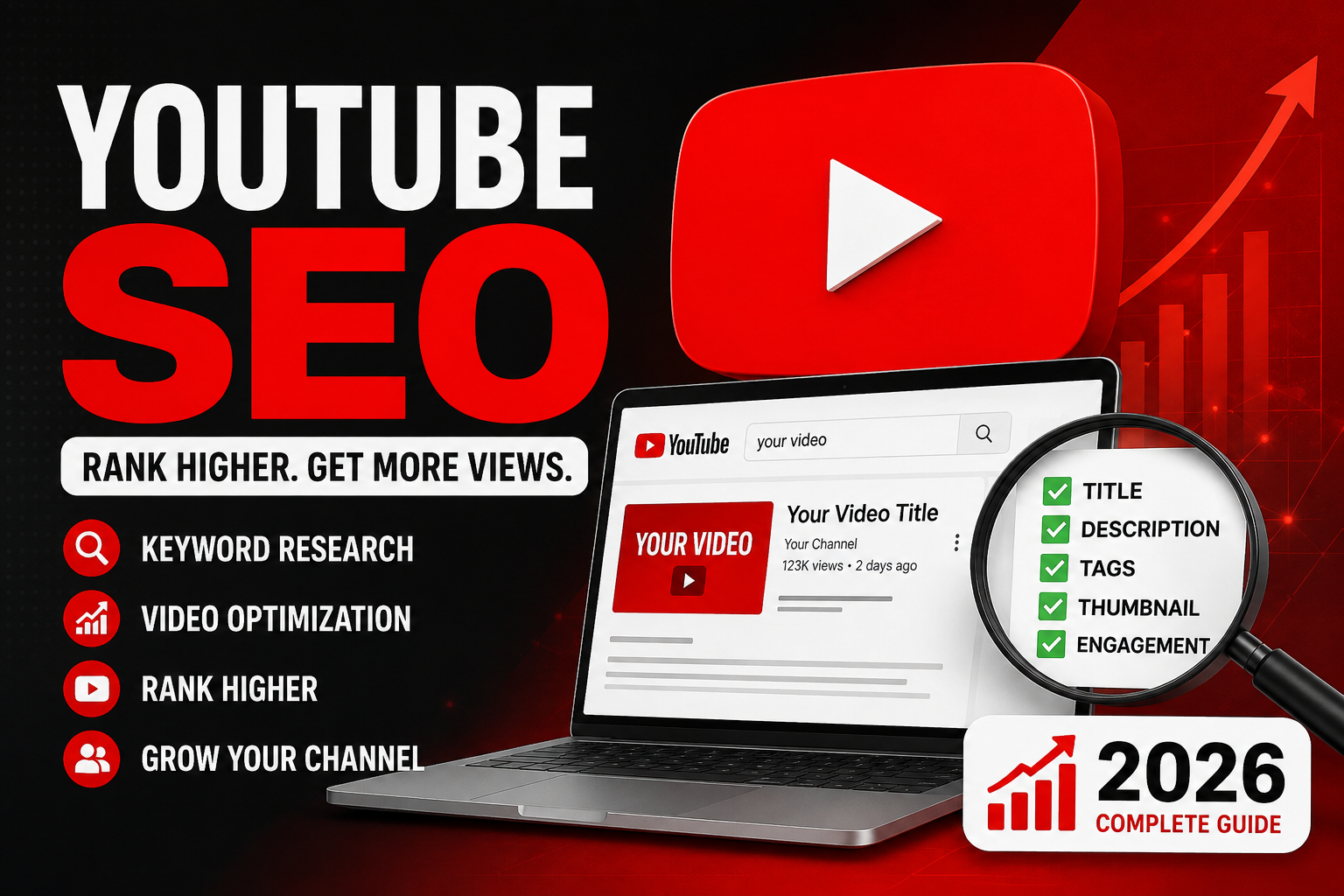
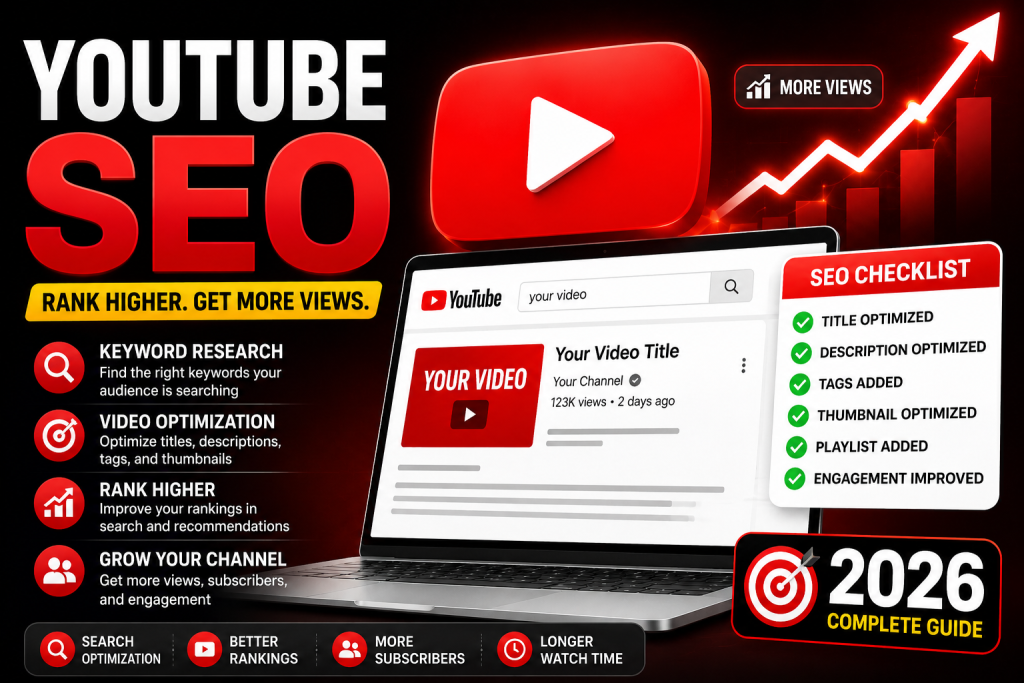
    YouTube SEO tips and strategies to rank videos higher and get more views in 2026

    Final Thoughts

    Effective YouTube SEO in 2026 is not about manipulating an algorithm with excessive keywords. It is about making your content easier to understand, easier to discover, and genuinely valuable to viewers.

    Focus on keyword research, compelling titles, useful descriptions, attractive thumbnails, strong audience retention, organized playlists, and consistent analytics review.

    Most importantly, remember that search optimization and viewer satisfaction should work together. When your video clearly answers a question and keeps viewers engaged, you are building a stronger foundation for long-term channel growth.

  • TikTok Marketing: The Complete Guide to Growing Your Business in 2026

    TikTok Marketing: The Complete Guide to Growing Your Business in 2026

    TikTok has evolved far beyond a platform for viral entertainment. In 2026, businesses can use short-form video, creator partnerships, search-friendly content, and paid advertising to attract customers, build brand awareness, and generate sales. For small businesses, ecommerce brands, service providers, and growing companies, TikTok Marketing can become an important part of a modern digital growth strategy.

    The biggest opportunity is not simply going viral. It is creating useful, entertaining, and authentic content that reaches people at the right stage of their buying journey.

    What Is TikTok Marketing?

    TikTok Marketing is the process of using TikTok content, creators, trends, advertising, and audience insights to promote a business, product, or service.

    Unlike traditional advertising, TikTok focuses heavily on entertainment and authenticity. A successful strategy does not always require expensive production. A smartphone, a strong idea, good storytelling, and consistent publishing can be enough to start building an audience.

    Businesses can use the platform to:

    • Increase brand awareness
    • Generate website traffic
    • Promote products and services
    • Build an engaged community
    • Generate leads
    • Drive online sales
    • Connect with creators and influencers

    TikTok itself recommends authentic content, relevant keywords, creator partnerships, and measurable campaigns as important components of business growth.

    Why TikTok Marketing Matters in 2026

    Consumer behavior continues to move toward short-form video and social discovery. People increasingly use social platforms to discover products, research ideas, compare options, and find recommendations.

    That creates an opportunity for businesses to appear naturally during the discovery process.

    A strong TikTok strategy can help a brand turn attention into measurable business results. Instead of focusing only on follower counts, businesses should connect their content to meaningful goals such as website visits, leads, purchases, or customer inquiries.

    TikTok also provides advertising and measurement tools that allow businesses to test creative ideas and optimize campaigns based on performance.

    7 Effective TikTok Marketing Strategies

    1. Create Authentic Short-Form Videos

    People do not necessarily expect every business video to look like a television commercial. Authenticity can make content feel more relatable.

    Show your products in real situations, answer customer questions, demonstrate your process, share behind-the-scenes moments, and explain common problems.

    For example, a local service company could create a short video explaining a common mistake customers make. An ecommerce brand could demonstrate how its product works in everyday life.

    The goal is simple: provide value while keeping viewers interested.

    2. Optimize Videos for TikTok Search

    TikTok has become an important discovery platform, making TikTok SEO increasingly valuable.

    Use relevant phrases naturally in your:

    • Video captions
    • On-screen text
    • Spoken dialogue
    • Hashtags
    • Titles and descriptions

    Instead of adding random popular hashtags, focus on phrases your potential customers might actually search for.

    For example, a fitness business could create content around phrases such as “beginner home workouts,” “easy strength training,” or “workout tips for beginners.”

    Relevant search terms help communicate what your content is about and can improve its discoverability.

    3. Use Trends Strategically

    Trends can help increase visibility, but businesses should avoid forcing every trend into their content calendar.

    Choose trends that naturally fit your brand, audience, and message.

    A clothing company might use a trending format to showcase outfit ideas. A restaurant could adapt a popular storytelling format to introduce a new menu item.

    The best approach is to combine TikTok trends with original ideas rather than simply copying whatever is popular.

    4. Work With Relevant Creators

    Creator marketing can help businesses reach established communities while making promotional content feel more natural.

    Instead of choosing a creator only because they have a large following, consider:

    • Audience relevance
    • Engagement quality
    • Content style
    • Brand alignment
    • Previous partnerships
    • Ability to communicate your product naturally

    TikTok academy recommends creator collaborations as a way to expand reach and build credibility, and its creator marketplace can help businesses discover potential partners.

    5. Experiment With TikTok Ads

    Organic content can build awareness, while TikTok Ads can help businesses reach specific audiences and scale successful creative.

    Advertisers can use different campaign objectives depending on whether they want more awareness, traffic, leads, app installs, or sales.

    A smart approach is to test multiple creative concepts instead of putting the entire budget behind one video. Compare hooks, messaging, visuals, calls to action, and audiences before scaling the strongest performers.

    TikTok’s current advertising guidance emphasizes testing and continuous optimization rather than assuming one creative approach will work forever.

    6. Encourage User-Generated Content

    User-generated content can provide social proof while giving brands additional creative material.

    Ask customers to demonstrate a product, share their experience, answer a question, or participate in a brand challenge.

    UGC can also become valuable advertising creative. TikTok’s Content Suite now helps advertisers identify relevant organic content and evaluate it for potential advertising use.

    7. Measure What Actually Matters

    Views are useful, but they are not the only measurement of success.

    Track metrics such as:

    • Watch time
    • Engagement rate
    • Profile visits
    • Website clicks
    • Leads
    • Conversions
    • Cost per lead
    • Return on ad spend

    A video with fewer views can sometimes generate more customers than a viral video with millions of views.

    This is why effective social media marketing should connect content performance with actual business objectives.

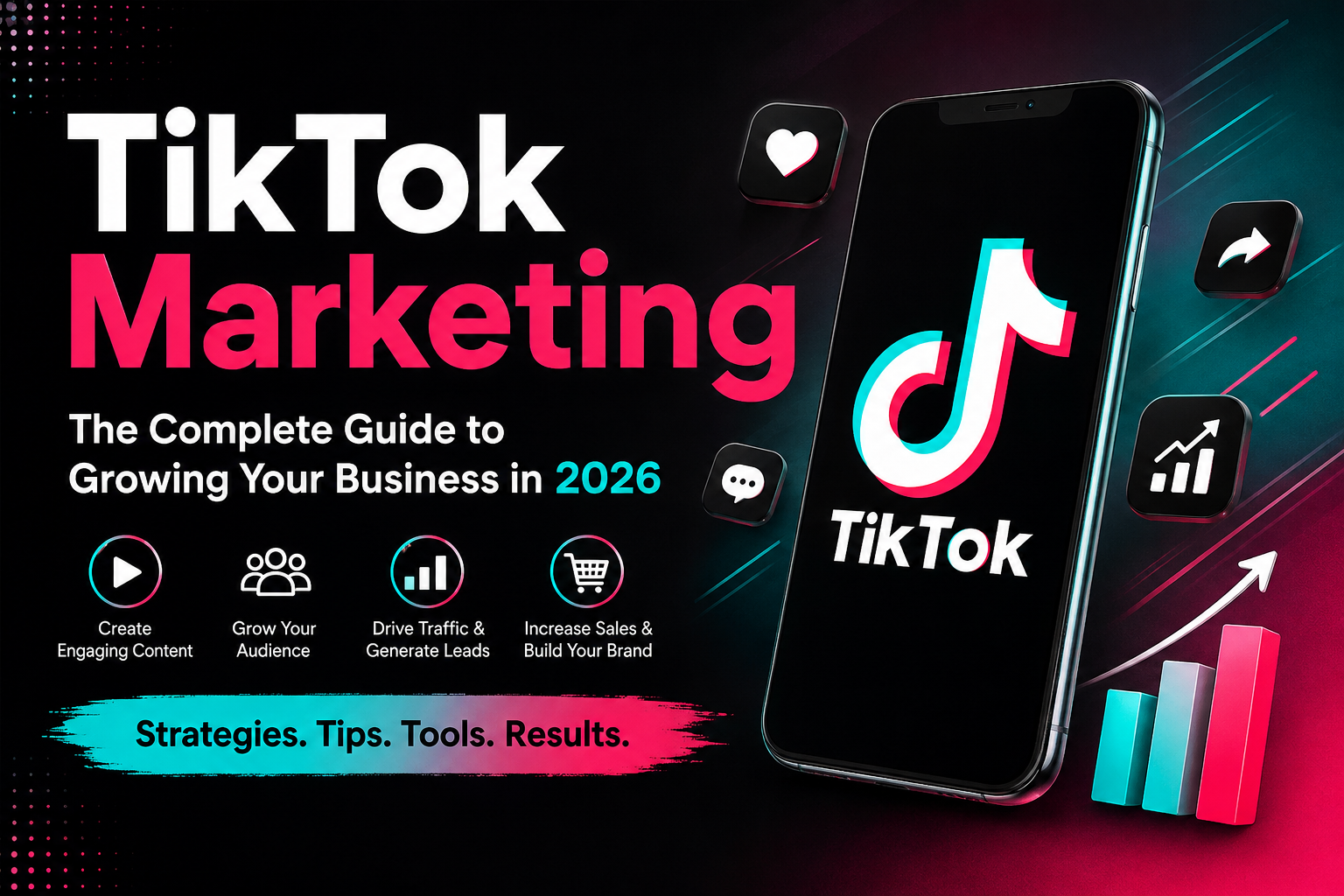
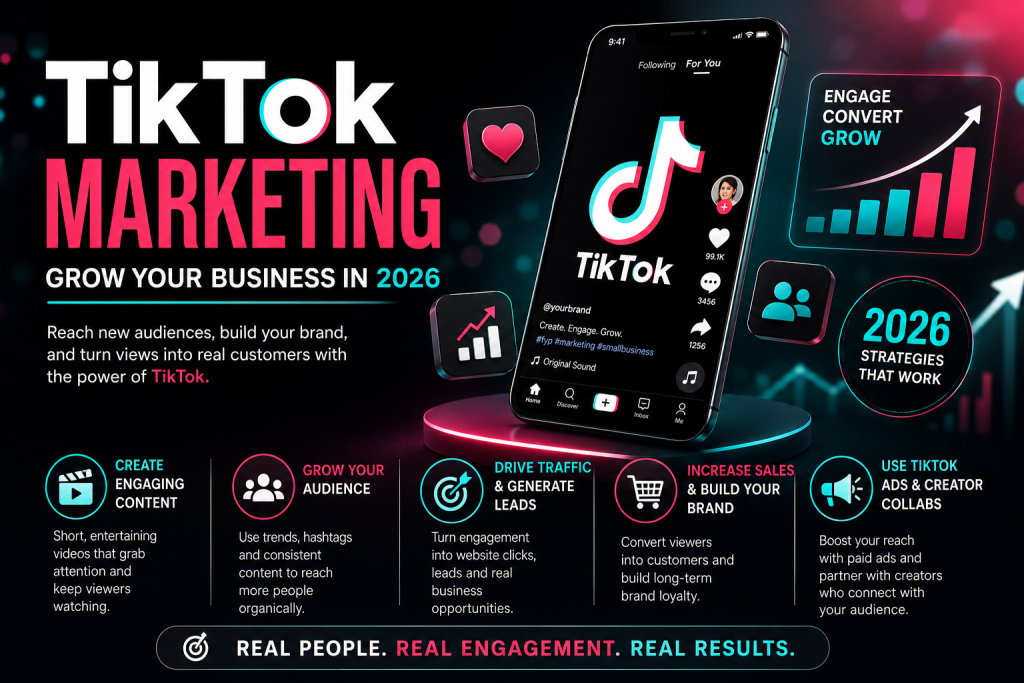
    Discover the best TikTok Marketing strategies for 2026, including TikTok SEO, content creation, ads, creator partnerships, trends, and business growth tips.

    Common TikTok Marketing Mistakes to Avoid

    Many businesses make the mistake of focusing entirely on viral content.

    Other common problems include posting inconsistently, copying competitors, using irrelevant hashtags, creating overly promotional videos, ignoring search behavior, and failing to analyze performance.

    Another mistake is abandoning a strategy after a few unsuccessful posts. Content performance can vary significantly. Instead of judging the entire strategy from one video, identify patterns across multiple posts.

    How to Build a TikTok Content Plan

    Start by choosing three to five content categories.

    For example:

    Educational: Answer customer questions and explain problems.

    Product: Demonstrate products and show practical benefits.

    Behind the scenes: Introduce employees, processes, or company culture.

    Social proof: Share testimonials, reviews, and customer experiences.

    Entertainment: Use relevant trends, humor, and storytelling.

    Then create a realistic publishing schedule. Consistency is more valuable than creating ten videos one week and disappearing for the next month.

    Final Thoughts

    Successful TikTok Marketing in 2026 is less about chasing random viral moments and more about building a repeatable content system.

    Create authentic short-form videos, understand what your audience searches for, use relevant trends, collaborate with the right creators, experiment with paid campaigns, and measure results beyond views.

    For businesses that consistently provide useful and entertaining content, TikTok can become more than a social platform. It can function as a discovery, branding, lead-generation, and sales channel within a broader digital marketing strategy.

  • Instagram Marketing in 2026: A Complete Guide to Growing Your Brand

    Instagram Marketing in 2026: A Complete Guide to Growing Your Brand

    Instagram Marketing has become one of the most effective ways for businesses, creators, and entrepreneurs to build visibility, connect with customers, and generate sales online. With billions of people using Instagram to discover products, follow brands, watch short-form videos, and research buying decisions, having a strong Instagram presence can give your business a major competitive advantage.

    In 2026, simply posting attractive pictures is no longer enough. Successful brands are combining Instagram SEO, Reels, Stories, influencer partnerships, community engagement, and paid advertising to reach the right audience and turn followers into customers.

    What Is Instagram Marketing?

    Instagram Marketing is the process of using Instagram to promote a business, product, service, personal brand, or organization. It includes organic content as well as paid campaigns designed to increase awareness, engagement, website traffic, leads, and sales.

    A complete Instagram marketing strategy can include:

    • Instagram Reels
    • Instagram Stories
    • Carousel posts
    • Live videos
    • Influencer collaborations
    • Paid Instagram advertising
    • User-generated content
    • Hashtag optimization
    • Instagram SEO
    • Community engagement

    The best approach depends on your goals, industry, audience, and content resources.

    Why Instagram Marketing Matters in 2026

    Instagram continues to be an important platform for visual discovery and brand building. People don’t only use social media for entertainment anymore. They also use it to discover businesses, compare products, read recommendations, and decide what they want to buy.

    For small businesses, Instagram can provide an affordable way to showcase products and establish credibility. For larger brands, it can become an important part of a broader digital marketing strategy.

    The key is to create content that provides value instead of constantly asking people to purchase something.

    Build a Strong Instagram Marketing Strategy

    Before publishing content, define what you want to accomplish. Your goal could be increasing followers, generating leads, driving website traffic, increasing sales, or building brand awareness.

    Start by identifying your ideal customer. Understand their interests, problems, questions, and purchasing behavior.

    Then create three to five content pillars. For example, a fitness brand might use:

    1. Educational fitness tips
    2. Workout demonstrations
    3. Customer transformations
    4. Product recommendations
    5. Behind-the-scenes content

    This makes your Instagram content strategy easier to manage and creates consistency across your profile.

    Use Instagram Reels to Increase Reach

    Short-form video remains one of the most powerful content formats on Instagram. Reels can introduce your brand to people who don’t already follow you.

    However, creating random videos is not enough. Each Reel should have a clear purpose.

    Start with a strong hook during the first few seconds. Explain one useful idea, demonstrate a product, answer a common question, or tell a short story.

    Keep videos visually engaging and make sure the message can be understood without relying completely on audio.

    Educational videos, product demonstrations, quick tutorials, industry tips, customer stories, and entertaining content can all become effective Reel formats.

    Improve Your Instagram SEO

    Instagram SEO helps your profile and content become easier to discover when people search for relevant topics.

    Use important keywords naturally in your:

    • Instagram username
    • Profile name
    • Bio
    • Captions
    • On-screen text
    • Relevant hashtags
    • Content topics

    For example, instead of creating a generic caption such as “Check this out,” a marketing agency could write about specific topics such as social media marketing tips, content planning, or online advertising.

    Avoid stuffing captions with repetitive keywords. Write for humans first and search engines second.

    Create Content That People Want to Share

    Likes are useful, but shares and saves can be especially valuable because they indicate that people found your content useful enough to keep or send to someone else.

    Create posts that solve problems, answer questions, simplify complicated topics, or provide practical information.

    For example, a financial brand could create a carousel explaining common budgeting mistakes. A software company could publish a tutorial showing customers how to use a specific feature.

    This type of educational content can strengthen authority while increasing engagement.

    Use Instagram Stories to Build Relationships

    Stories are excellent for maintaining regular contact with your existing audience.

    You can use Stories for:

    • Polls
    • Questions
    • Product announcements
    • Behind-the-scenes content
    • Customer reviews
    • Limited-time offers
    • Tutorials
    • New post notifications

    Stories also make a brand feel more human. Instead of making every post look perfectly polished, show the people, process, and personality behind your business.

    Consider Instagram Advertising

    Organic content is only one part of a complete strategy. Instagram advertising can help businesses reach specific audiences based on factors such as interests, behaviors, demographics, and previous interactions.

    Paid campaigns can be used to promote products, generate leads, increase website traffic, or retarget people who have already interacted with your brand.

    Start with a small budget, test different creative formats, and analyze performance before increasing spending.

    Work With Creators and Influencers

    Influencer marketing can help brands reach established communities with strong audience trust.

    Instead of choosing a creator only because they have a large following, look at audience relevance, engagement, content quality, and credibility.

    A smaller creator with a highly relevant audience may deliver better results than a large account with weak engagement.

    Measure Your Results

    Successful social media growth requires consistent measurement.

    Track metrics such as:

    • Reach
    • Engagement rate
    • Saves
    • Shares
    • Profile visits
    • Website clicks
    • Leads
    • Sales
    • Follower growth

    Don’t focus only on follower numbers. A smaller audience that regularly engages with your content and purchases your products can be more valuable than thousands of inactive followers.

    Instagram Marketing 2026 complete guide with Instagram profile, Reels, audience engagement, brand growth, and analytics on a smartphone.

    Final Thoughts

    A successful Instagram Marketing strategy in 2026 is built around useful content, strong branding, discoverability, authentic communication, and consistent testing.

    Focus on understanding your audience rather than chasing every trend. Combine Reels, Stories, carousels, Instagram SEO, community engagement, and paid campaigns according to your business goals.

    Most importantly, stay consistent. Your results may not appear overnight, but publishing valuable content regularly can gradually build trust, visibility, and a loyal customer base.

    Whether you are launching a small business, growing a personal brand, or promoting an established company, Instagram can become a powerful part of your digital marketing strategy when it is approached with a clear plan and measurable goals.

  • Facebook Marketing in 2026: A Complete Guide to Growing Your Business Online

    Facebook Marketing in 2026: A Complete Guide to Growing Your Business Online

    What Is Facebook Marketing?

    Facebook Marketing is the process of using Facebook to promote a business, build brand awareness, attract potential customers, generate leads, and increase sales. For businesses of all sizes, it can be an important part of a broader social media marketing strategy.

    A successful campaign is not simply about posting promotional content. It combines valuable content, audience targeting, creative visuals, community engagement, advertising, and performance tracking.

    In 2026, businesses should focus less on posting frequently and more on creating content that gives people a reason to stop, watch, interact, click, or purchase.

    Why Facebook Marketing Still Matters in 2026

    The biggest advantage of Facebook is its combination of content, communities, business pages, and paid advertising tools.

    A well-optimized Facebook business page can give potential customers essential information about your company while providing a place where your audience can interact with your brand.

    Paid campaigns can complement organic content by helping businesses reach specific audiences based on available targeting signals such as location, interests, behaviors, and customer information. Meta has also highlighted tools such as Custom Audiences and Lookalike Audiences for reaching existing customers and finding people similar to valuable audiences.

    This makes the platform useful for local businesses, ecommerce brands, service providers, creators, startups, and established companies.

    Build a Strong Facebook Business Page

    Before spending money on advertising, create a professional Facebook business page.

    Your page should include:

    • A recognizable profile image or logo
    • A professional cover image
    • A clear business description
    • Website and contact information
    • Relevant business category
    • A strong call to action
    • Consistent branding

    Your page should immediately answer three questions: What do you offer? Who is it for? Why should someone trust you?

    Complete and consistent information can make your business appear more professional and give visitors a clearer path toward contacting or purchasing from you.

    Create a Powerful Content Strategy

    Content is the foundation of long-term social media marketing.

    Instead of publishing the same promotional message repeatedly, create different types of content around your customers’ needs.

    1. Educational Content

    Teach your audience something useful. Share tutorials, checklists, tips, mistakes to avoid, and simple explanations.

    2. Problem-Solving Content

    Identify common customer problems and explain practical solutions. This type of content can position your brand as a helpful resource rather than just another advertiser.

    3. Video Content

    Short-form video can capture attention quickly. Demonstrations, product explainers, behind-the-scenes clips, customer stories, and quick tips can all become valuable parts of your content plan.

    4. Social Proof

    Customer reviews, testimonials, case studies, and user-generated content can help reduce uncertainty before someone makes a purchase.

    5. Promotional Content

    Promotions should have a purpose. Instead of constantly saying “Buy Now,” explain the value of the product or service and give customers a clear reason to take action.

    Use Facebook Ads Strategically

    Facebook ads can accelerate your reach when they are supported by a clear objective.

    Depending on the business, advertising campaigns can be designed around goals such as awareness, traffic, engagement, leads, app promotion, or sales.

    Strong Facebook advertising starts with the right audience and offer. A beautiful advertisement will not perform well if it is shown to people who have little interest in the product.

    Audience targeting should therefore be based on customer research rather than assumptions.

    For example, an online fitness brand could create different campaigns for people interested in workout programs, existing customers, and visitors who have already interacted with its website.

    Focus on Audience Targeting

    Audience targeting is one of the most important parts of a Facebook marketing strategy.

    Start by defining your ideal customer:

    • Age range
    • Location
    • Interests
    • Buying behavior
    • Common problems
    • Preferred products
    • Purchase intent

    Businesses with existing customer data can also explore Custom Audiences and similar audience strategies where available. Meta’s own resources describe Custom Audiences as a way to reach existing customer groups and Lookalike Audiences as a method for finding people similar to existing audiences.

    The key is to continually test which audiences produce meaningful results.

    Optimize Your Facebook Advertising

    Don’t judge an advertising campaign only by likes.

    Track metrics that connect activity to business outcomes, including:

    • Click-through rate
    • Cost per click
    • Cost per lead
    • Conversion rate
    • Return on ad spend
    • Website purchases
    • Qualified leads

    Testing is equally important. Try different headlines, images, videos, offers, calls to action, and audience segments.

    Meta’s advertising ecosystem also emphasizes testing and optimization across different formats and placements.

    Facebook Marketing 2026 guide featuring a laptop, smartphone, Facebook business page, audience targeting, advertising analytics, engagement, and lead generation.

    Use Reels and Visual Content

    Visual content deserves a major place in your 2026 social media strategy.

    Short videos can communicate an idea faster than long blocks of text. Businesses can use them to demonstrate products, answer frequently asked questions, show transformations, introduce team members, or explain industry concepts.

    Keep videos focused on one idea. Capture attention quickly, use readable text when appropriate, and finish with a relevant next step.

    Build a Community, Not Just Followers

    A strong social media presence is more than a follower count.

    Respond to comments, answer questions, acknowledge customer feedback, and participate in relevant conversations. When people feel that a business is accessible and responsive, they are more likely to remember it.

    Community engagement can also provide valuable information about customer objections, preferences, and frequently asked questions. Those insights can then become future content ideas.

    Measure and Improve Your Strategy

    The best Facebook marketing strategy is never completely finished.

    Review your performance regularly and identify:

    What worked?
    Find posts, videos, audiences, and offers that generated meaningful engagement or conversions.

    What failed?
    Stop wasting resources on campaigns that consistently produce poor results.

    What can be tested?
    Change one major variable at a time so you can understand what influenced performance.

    Use your data to improve future campaigns instead of relying entirely on assumptions.

    Final Thoughts

    Facebook Marketing in 2026 is about much more than publishing posts. Businesses that combine useful content, strong branding, audience targeting, community engagement, paid advertising, and consistent measurement can build a stronger digital presence.

    The most effective approach is to understand your customers first, create content that genuinely helps them, and use advertising to amplify proven ideas.

    Whether you run a local company, ecommerce store, professional service, or growing online brand, a well-planned strategy can turn social media activity into measurable business results.

    Start with one clear audience, one valuable offer, and one measurable goal—and improve from there.

  • Email Marketing: The Complete Guide to Growing Your Business in 2026

    Email Marketing: The Complete Guide to Growing Your Business in 2026

    Email marketing remains one of the most effective ways for businesses, creators, ecommerce brands, and service providers to connect directly with customers. Unlike social media, where algorithms can determine who sees your content, email gives you a direct communication channel with people who have chosen to hear from you.

    In 2026, successful businesses are using personalized messages, automation, segmentation, and valuable content to build stronger customer relationships and generate consistent sales.

    What Is Email Marketing?

    Email marketing is the practice of sending targeted messages to subscribers through email. These messages can include promotional offers, educational content, product announcements, company updates, newsletters, or personalized recommendations.

    A strong strategy is not simply about sending as many emails as possible. It is about delivering the right message to the right person at the right time.

    For example, an online store might send a welcome email after someone joins its list, followed by product recommendations and a special offer. A consulting business may use an email newsletter to share useful insights and encourage potential clients to schedule a consultation.

    Why Is Email Marketing Important in 2026?

    Digital competition continues to increase, making direct customer communication more valuable than ever. A well-managed email list can become a long-term business asset.

    There are several reasons companies continue to invest in this channel:

    • Direct communication: Messages reach subscribers in their inboxes.
    • Customer relationships: Consistent, useful content can increase trust.
    • Personalization: Businesses can customize messages based on customer behavior.
    • Automation: Repetitive communication can happen automatically.
    • Measurable results: Marketers can track opens, clicks, conversions, and revenue.
    • Cost efficiency: Businesses can communicate with large audiences without relying entirely on paid advertising.

    The key is to focus on providing genuine value rather than overwhelming subscribers with promotional messages.

    How to Build an Email List

    Successful email campaigns begin with a quality subscriber list. Instead of purchasing random email addresses, businesses should encourage interested visitors to voluntarily subscribe.

    Effective email list building methods include:

    1. Offer a Valuable Incentive

    Give visitors a useful reason to subscribe. This could be a discount, checklist, guide, template, free resource, or exclusive content.

    2. Use Website Signup Forms

    Place signup forms on relevant pages of your website. A simple headline and clear benefit can make the subscription process more effective.

    3. Create Dedicated Landing Pages

    A focused landing page can encourage visitors to exchange their email address for something valuable.

    4. Make the Benefit Clear

    Tell people exactly what they will receive after subscribing. For example, you might promise weekly tips, exclusive deals, or helpful industry insights.

    Always use permission-based collection practices and provide an easy way for subscribers to unsubscribe.

    Creating Effective Email Marketing Campaigns

    A successful campaign begins with a clear objective. Before writing an email, determine what you want the reader to do.

    Possible goals include:

    • Purchasing a product
    • Booking a service
    • Reading an article
    • Downloading a resource
    • Registering for an event
    • Returning to an abandoned cart

    Your subject line should create interest without misleading the reader. The body should be easy to scan, with short paragraphs, useful information, and a clear call to action.

    Avoid trying to accomplish too many things in one message. A focused email usually makes the desired action easier to understand.

    Email Marketing Automation

    Email marketing automation allows businesses to send timely messages based on specific actions or events.

    Common automated workflows include:

    • Welcome sequences
    • Abandoned cart reminders
    • Post-purchase follow-ups
    • Re-engagement campaigns
    • Birthday or anniversary messages
    • Product recommendation emails
    • Lead nurturing sequences

    For example, when someone subscribes to a newsletter, an automated sequence can introduce the business, provide educational content, and eventually present a relevant product or service.

    This approach saves time while creating a more consistent customer experience.

    Personalization and Segmentation

    Sending the same message to everyone is rarely the best approach. Segmentation allows marketers to divide subscribers into groups based on characteristics or behavior.

    You could segment subscribers by:

    • Purchase history
    • Location
    • Interests
    • Website activity
    • Engagement level
    • Customer type
    • Previous interactions

    Personalized communication can make messages more relevant and help businesses avoid sending unnecessary promotions to people who are not interested.

    Best Email Marketing Tools

    The right email marketing tools can simplify list management, automation, analytics, segmentation, and campaign creation.

    When choosing a platform, look for features such as:

    • Drag-and-drop email creation
    • Automation workflows
    • Subscriber segmentation
    • Analytics and reporting
    • Mobile-friendly templates
    • A/B testing
    • Signup forms
    • Integration with your website or ecommerce platform

    The best platform depends on your business size, audience, budget, and technical requirements.

    Email Marketing Best Practices

    Following proven email marketing best practices can improve engagement and protect the quality of your subscriber list.

    First, send useful content consistently instead of contacting subscribers only when you want to make a sale. Second, optimize emails for mobile devices because many people read messages on smartphones.

    You should also test different subject lines, calls to action, layouts, and sending times. Monitor important metrics such as click-through rate, conversion rate, unsubscribe rate, and revenue generated from campaigns.

    Most importantly, respect subscriber preferences and applicable email communication laws. Make it easy for recipients to understand who is contacting them and how they can stop receiving messages.

    Email marketing strategy with audience growth, automation, engagement, and conversion analytics

    Common Mistakes to Avoid

    Even a well-designed campaign can fail because of simple mistakes.

    Avoid buying email lists, sending excessive promotional messages, using misleading subject lines, ignoring mobile users, and failing to remove consistently inactive subscribers.

    Another common mistake is focusing only on open rates. Opens can provide useful directional information, but clicks, conversions, customer actions, and revenue are often more meaningful indicators of business performance.

    Final Thoughts

    Email marketing is still a powerful digital marketing channel in 2026 because it combines direct communication, personalization, automation, and measurable performance.

    The strongest approach is not to send more emails—it is to send more relevant emails. Build a permission-based list, understand your audience, create valuable content, automate repetitive journeys, and continuously improve campaigns using real performance data.

    Whether you run an ecommerce store, professional service, startup, personal brand, or established company, a thoughtful email marketing strategy can help turn subscribers into engaged customers and long-term supporters.