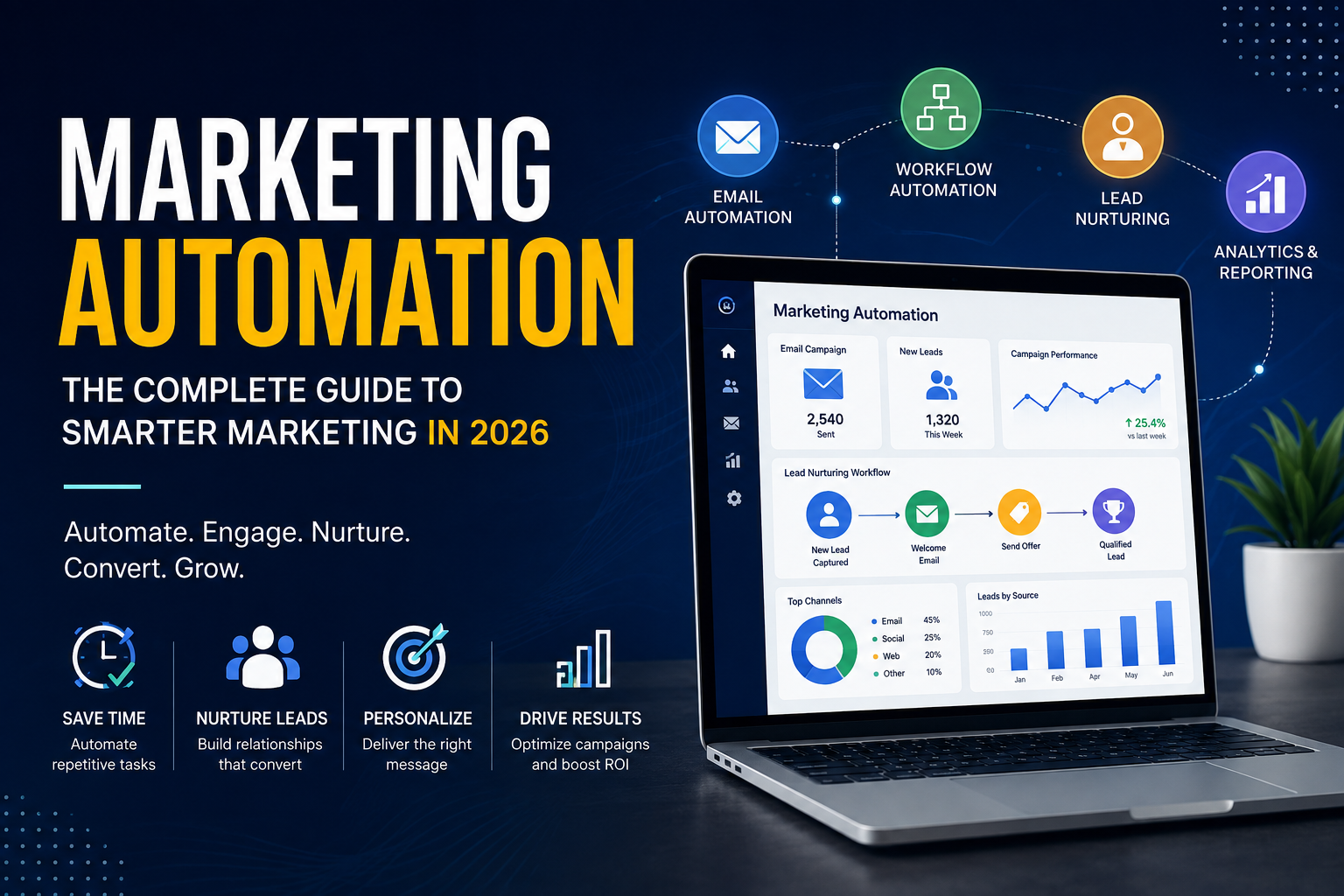
Marketing is becoming more competitive, and businesses can no longer depend entirely on manual campaigns and repetitive follow-ups. In 2026, companies are increasingly using technology to create personalized experiences, nurture prospects, and improve marketing efficiency. Marketing automation makes this possible by using software and automated workflows to perform repetitive marketing tasks based on customer actions and predefined rules.
Instead of sending every email manually or checking every lead individually, businesses can create systems that respond automatically when a customer visits a website, submits a form, downloads content, or interacts with a campaign. Salesforce describes automation as technology that manages marketing processes and campaigns across channels such as email, web, social, and text.
What Is Marketing Automation?
Marketing automation is the use of software to automate repetitive marketing activities while delivering relevant messages to customers at the right stage of their journey.
For example, when someone signs up for a newsletter, an automated system can immediately send a welcome email. If that person later downloads an ebook, the system can send educational content and notify the sales team when the lead becomes highly engaged.
This approach combines email marketing automation, lead nurturing, customer segmentation, and CRM automation into a connected process.
The goal is not simply to send more messages. The goal is to deliver more relevant communication while allowing marketing teams to spend more time on strategy, creativity, and growth.
How Does Marketing Automation Work?
Most automated systems operate through triggers, conditions, and actions.
A trigger starts the workflow. This could be a form submission, website visit, email interaction, purchase, or content download. The system then evaluates conditions and performs a specific action.
For example:
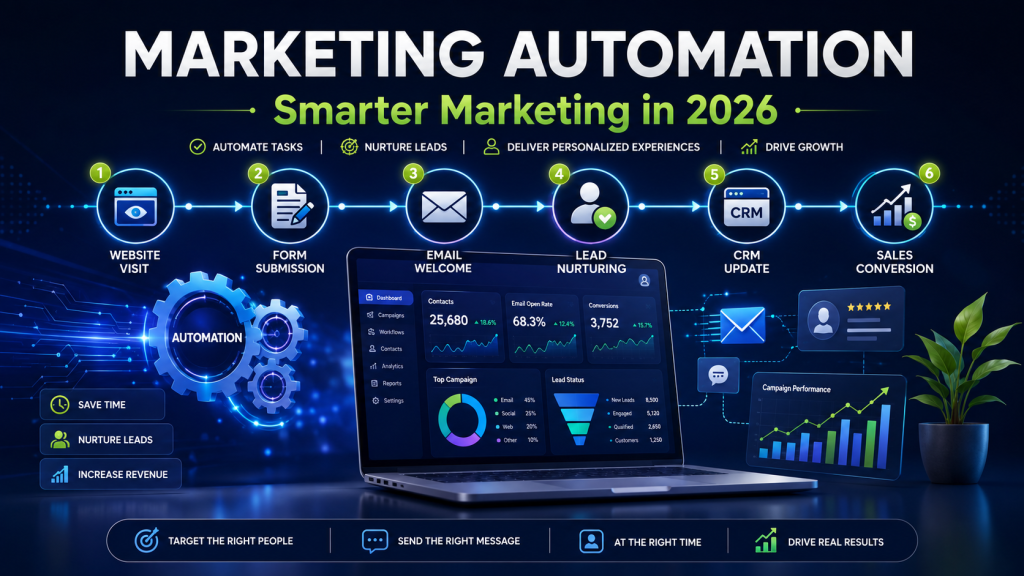
Website visitor → Form submission → Welcome email → Educational content → Lead scoring → Sales notification
Modern workflow automation platforms can also update CRM records, assign leads, send notifications, and trigger follow-up activities automatically.
This creates a smoother customer journey without requiring marketers to manually manage every interaction.
Key Benefits of Marketing Automation
1. Saves Time
One of the biggest advantages is reducing repetitive work. Marketing teams can automate routine emails, lead assignments, follow-ups, audience segmentation, and campaign actions.
Once a workflow has been properly configured, it can continue operating without someone manually starting every task.
2. Improves Lead Nurturing
Not every prospect is ready to buy immediately. Lead nurturing helps businesses build relationships by providing useful information over time.
For example, a new prospect might receive educational content first, followed by a case study, product information, and eventually a sales invitation.
HubSpot’s current guidance emphasizes that automation is particularly useful for delivering behavior-triggered content according to what a contact actually does rather than sending identical messages to everyone.
3. Creates Personalized Customer Experiences
Customers expect relevant communication. Automation allows businesses to segment audiences based on interests, behavior, location, purchase history, and engagement.
A customer who repeatedly views a particular service page can receive content related to that service, while another customer can enter a completely different workflow.
4. Helps Sales and Marketing Work Together
CRM automation can connect marketing activity with sales processes. When a prospect reaches a specific engagement level, the system can update the CRM, assign the lead, or create a follow-up task.
This reduces delays between marketing and sales and gives teams better visibility into customer activity.
5. Measures Campaign Performance
Automated systems can track important metrics such as email engagement, conversions, lead progression, campaign performance, and revenue-related outcomes.
These insights help businesses identify which campaigns are working and where improvements are needed.
Best Marketing Automation Strategies for 2026
Businesses should focus on practical workflows rather than automating everything at once.
Welcome sequences: Introduce new subscribers to your brand and guide them toward useful resources.
Lead nurturing campaigns: Deliver educational content based on customer interests and engagement.
Abandoned-cart reminders: Remind potential buyers about products they left behind.
Re-engagement campaigns: Reach inactive subscribers with useful offers or content.
Post-purchase workflows: Provide order information, product education, reviews, and future offers.
Lead scoring: Prioritize prospects based on their interactions and level of interest.
These automated marketing campaigns can help create consistent communication throughout the customer lifecycle.
How to Choose Marketing Automation Software
Choosing the right platform depends on business size, marketing goals, budget, integrations, and technical requirements.
Look for features such as:
- Email campaign automation
- CRM integration
- Lead scoring
- Audience segmentation
- Landing page and form integration
- Analytics and reporting
- Workflow builders
- Customer journey automation
- Third-party integrations
- AI-assisted workflow creation
Popular platforms include HubSpot, Salesforce, Active Campaign, and other specialized marketing technology providers. The best choice is not necessarily the platform with the largest feature list. It is the one that fits your existing processes and can scale with your business.
Common Mistakes to Avoid
Automation can create problems when workflows are poorly planned. Sending too many messages can frustrate subscribers, while incorrect segmentation can deliver irrelevant content.
Businesses should also avoid creating complicated workflows before understanding their customer journey.
Start with simple processes, test each workflow, monitor performance, and improve campaigns based on real customer behavior. Automation should support human strategy rather than completely replace it.
Is Marketing Automation Worth It in 2026?
Yes, when implemented strategically. Modern businesses need to communicate quickly while maintaining personalization and consistency. Automation helps teams manage growing audiences without increasing manual workload at the same rate.
The strongest strategy combines automation with high-quality content, accurate customer data, thoughtful segmentation, and human creativity.
Final Thoughts
Marketing automation is no longer just an advanced feature for large companies. It has become an important part of modern digital marketing because businesses of different sizes can use automated workflows to save time, nurture leads, personalize communication, and improve campaign performance.
The key is to automate repetitive tasks while keeping the customer experience human. Start with one valuable workflow, measure the results, and gradually expand your automation strategy. With the right approach, automation can become a powerful foundation for sustainable marketing growth in 2026.
Leave a Reply