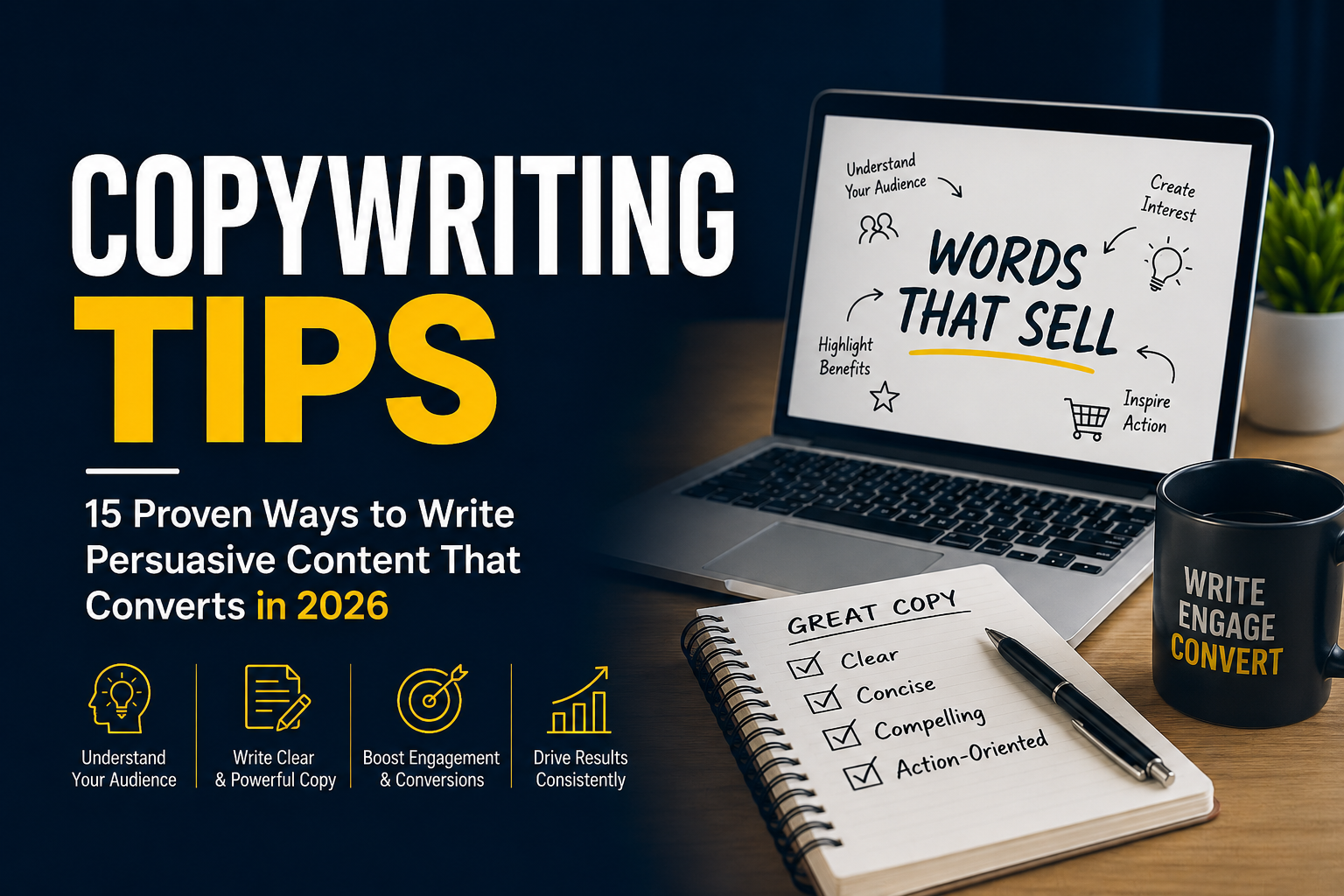
Great copywriting is not about using complicated words or sounding clever. It is about understanding what readers want, addressing their problems, and giving them a clear reason to take action. Whether you are writing website pages, product descriptions, emails, advertisements, or social media content, strong copy can turn attention into clicks, leads, and sales.
In 2026, competition for online attention is higher than ever. That makes persuasive writing, clear messaging, and customer-focused content essential for businesses and creators. The following copywriting tips can help you create content that is easier to read, more engaging, and more effective.
1. Know Your Target Audience
Before writing a single sentence, understand who you are speaking to. Identify your audience’s needs, goals, frustrations, objections, and buying motivations.
Instead of writing generic content, use language that reflects the real problems your readers experience. For example, a marketing agency should focus on business growth, qualified leads, visibility, and return on investment rather than simply describing its services.
Audience research is one of the most important foundations of effective copywriting tips.
2. Start With a Powerful Headline
Your headline determines whether many people will continue reading. A strong headline should communicate a benefit, create curiosity, or address a specific problem.
Compare:
Weak:
“Digital Marketing Services”
Stronger:
“Turn More Website Visitors Into Paying Customers With Smarter Digital Marketing”
The second headline gives readers a clear reason to continue.
Use your primary keyword naturally when it fits, but never sacrifice clarity just to include a keyword.
3. Focus on Benefits, Not Just Features
One of the most valuable copywriting tips is learning the difference between features and benefits.
A feature tells people what something has. A benefit explains why they should care.
For example:
Feature: “Our software provides automated reporting.”
Benefit: “Save hours every week with reports that generate automatically.”
Benefits connect directly with the reader’s desired outcome. When creating sales copy, explain how your product or service can make life easier, save time, reduce costs, or solve a specific problem.
4. Use Simple and Conversational Language
Readers do not want to decode complicated sentences. Write the way a knowledgeable person would naturally explain something to another person.
Avoid unnecessary jargon, long introductions, and overly complex vocabulary. Keep paragraphs short and make your sentences easy to scan.
Simple writing does not mean boring writing. It means removing anything that makes the message harder to understand.
5. Create a Strong Value Proposition
Your value proposition should quickly answer three questions:
- What do you offer?
- Who is it for?
- Why should someone choose you?
A strong value proposition separates your business from competitors and communicates your unique advantage.
For example, instead of saying “We provide SEO services,” you could say, “We help growing businesses improve search visibility and attract more qualified organic traffic.”
Specificity makes your message more convincing.
6. Use Storytelling to Build Connection
People remember stories more easily than lists of facts. Storytelling can make brand messaging more relatable and emotionally engaging.
You can describe a customer’s problem, explain the challenge they faced, and show how the solution produced a positive outcome.
A simple structure is:
Problem → Struggle → Solution → Result
This approach works particularly well for landing pages, case studies, email marketing, and brand storytelling.
7. Write for Scanners
Most online readers scan before they decide to read deeply. Make your content easy to navigate.
Use:
- Short paragraphs
- Descriptive headings
- Bullet points
- Bold emphasis where appropriate
- Clear transitions
- Plenty of white space
This improves readability and helps visitors quickly locate the information they need.
8. Use Persuasive Words Carefully
Persuasive writing does not require aggressive sales language. Instead, choose words that communicate value, confidence, and relevance.
Words such as proven, practical, reliable, simple, powerful, flexible, affordable, effective, and results-driven can strengthen messaging when they accurately describe your offer.
Avoid exaggerated claims that you cannot support. Trust is more valuable than hype.
9. Address Customer Objections
Potential customers often have questions before taking action.
They may wonder:
- Is this worth the price?
- Will it work for my situation?
- How difficult is it to use?
- Can I trust this company?
- What happens if I need help?
Address these concerns directly in your copy. Adding testimonials, guarantees, demonstrations, FAQs, reviews, or evidence can reduce uncertainty and increase conversions.
10. Add a Clear Call to Action
Every piece of marketing copy should have a purpose. Your call to action tells readers what to do next.
Instead of generic phrases like “Click Here,” use action-oriented language such as:
Get Your Free Quote
Start Your Free Trial
Book a Consultation
Download the Guide
Learn More
A clear CTA removes confusion and makes the next step obvious.
11. Optimize Content for Search Intent
SEO copywriting is not simply about repeating keywords. Search engines increasingly prioritize useful content writing tips that satisfies the reason behind a search.
If someone searches for “best email marketing software,” they probably want comparisons, features, pricing information, and recommendations.
Understand the search intent first, then create content that answers the user’s actual question.
Use your primary keyword naturally in strategic locations such as the title, introduction, headings, URL, and relevant sections. Avoid keyword stuffing because unnatural repetition can damage readability and user experience.
12. Build Trust With Specific Evidence
Specific information is usually more persuasive than vague promises.
Instead of saying:
“We deliver amazing results.”
Say:
“Our campaign generated 42% more qualified leads within three months.”
Whenever possible, support claims with data, testimonials, case studies, customer experiences, certifications, or recognizable proof.
Credibility can make the difference between a visitor leaving and becoming a customer.
13. Edit Ruthlessly
Your first draft is rarely your best draft. Strong writers improve their work through editing.
After finishing, remove unnecessary words, repeated ideas, weak openings, and confusing sentences. Look for places where you can make the message shorter and clearer.
Read the copy aloud. If a sentence sounds unnatural when spoken, rewrite it.
A useful editing question is:
“Does this sentence help the reader?”
If it does not, consider removing it.
14. Test Different Versions
There is no universal formula for perfect marketing copy. What works for one business may not work for another.
Test different:
- Headlines
- CTAs
- Offers
- Opening sentences
- Benefits
- Page layouts
- Email subject lines
A/B testing can reveal which messages generate better engagement and conversions. Use actual performance data rather than relying only on assumptions.
15. Keep Improving Your Copywriting Skills
The best writers continuously study customer behavior, advertising, psychology, SEO, and communication.
Read successful landing pages. Analyze advertisements. Study high-performing email campaigns. Pay attention to the words customers use when describing their problems.
Most importantly, practice regularly.
Final Thoughts
Effective copywriting combines psychology, clarity, research, storytelling, and strategy. The goal is not simply to produce attractive sentences—it is to communicate value and motivate the reader to take the next step.
These copywriting tips can help you create stronger website content, landing pages, emails, advertisements, product descriptions, and social media messages throughout 2026.
Remember the core principle: write for people first, then optimize for search. When your content genuinely answers questions, solves problems, builds trust, and communicates benefits clearly, it has a much better chance of attracting attention and converting readers into customers.
Leave a Reply