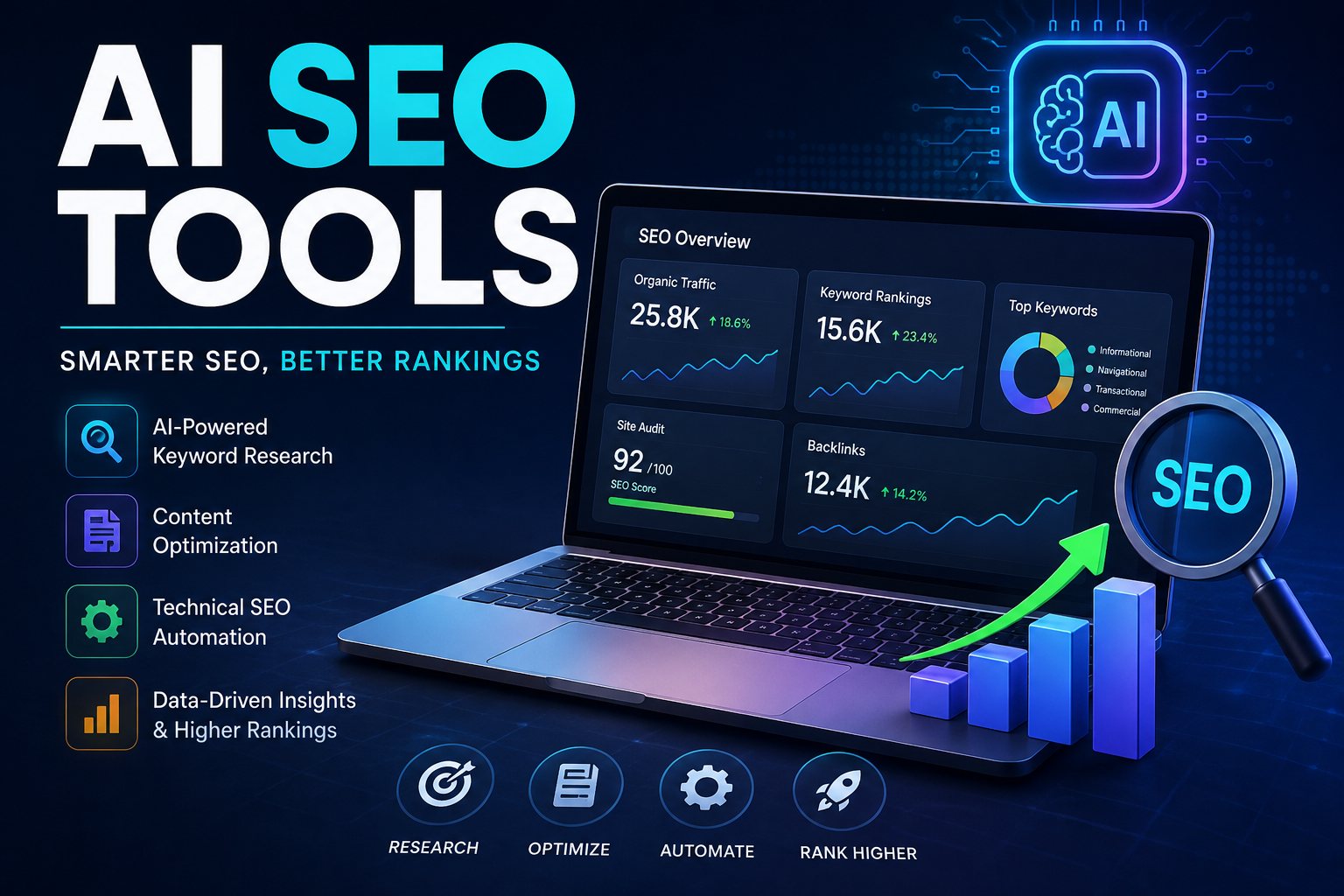
Search engine optimization is changing rapidly in 2026. Search engines are becoming better at understanding search intent, content quality, context, and user experience. At the same time, artificial intelligence is helping marketers research keywords, optimize content, analyze competitors, identify technical issues, and build smarter SEO strategies.
For businesses, bloggers, agencies, and content creators, AI SEO Tools can make the optimization process faster and more efficient. However, the best results come from combining AI-powered workflows with human expertise, original insights, and useful content.
Google’s current guidance makes an important point: AI can assist with content creation and research, but websites still need accurate, original, high-quality, people-first content. Automatically producing large amounts of low-value pages simply to manipulate rankings can violate Google’s spam policies.
What Are AI SEO Tools?
AI SEO Tools are software solutions that use artificial intelligence and machine learning to simplify different parts of search engine optimization. Instead of manually analyzing hundreds of keywords, pages, competitors, or content opportunities, marketers can use AI to identify patterns and generate useful recommendations.
Depending on the platform, an AI-powered SEO workflow can help with:
- Keyword research
- Search intent analysis
- Content optimization
- Competitor research
- Content briefs
- On-page SEO
- Technical SEO analysis
- Internal linking
- SERP analysis
- Content gap research
- SEO reporting
The biggest advantage is efficiency. Tasks that previously required hours of manual research can often be completed much faster with the right workflow.
Why AI SEO Tools Matter in 2026
Search is no longer limited to traditional blue-link results. Google’s generative AI features are changing how people discover and consume information.
In May 2026, Google published a dedicated guide explaining how website owners can optimize for generative AI features in Search. Google emphasized that established SEO fundamentals remain important and that websites should focus on valuable, unique content rather than creating large volumes of pages for search manipulation.
This means your strategy should not simply be about adding more keywords. Your content needs to answer questions clearly, demonstrate expertise, provide useful information, and satisfy the visitor.
1. Use AI for Smarter Keyword Research
AI Keyword research tools remains one of the foundations of SEO. AI can help you move beyond simple keyword lists by organizing queries according to search intent.
For example, instead of targeting only a broad phrase such as “digital marketing,” you can identify related searches around:
- Digital marketing strategies
- Digital marketing for small businesses
- Online marketing ideas
- Content marketing strategies
- Search engine optimization tips
- Local search optimization
This approach helps create topic clusters and gives your website broader topical coverage.
The goal should not be to insert every keyword into one article. Instead, choose terms that genuinely support the reader’s search journey.
2. Improve Content Optimization
One of the strongest uses of AI SEO Tools is content analysis. Modern SEO software can evaluate headings, keyword coverage, topic relevance, readability, and content structure.
You can use these insights to identify missing subtopics and improve an existing article.
However, optimization should never make content sound robotic. Google states that its systems aim to reward helpful, reliable information created primarily for people.
A better workflow is simple: let AI identify opportunities, then use human judgment to add examples, experience, opinions, original research, and useful explanations.
3. Analyze Competitors More Efficiently
Competitor analysis can reveal why certain pages are performing well.
AI-powered SEO platforms can help you examine competing content and identify patterns such as:
- Topics they cover
- Keywords they target
- Questions they answer
- Content formats they use
- Potential content gaps
- Pages that attract search visibility
But copying competitors is not a winning strategy.
Instead, use competitor analysis to discover what users expect and then create something more useful, specific, and original.
4. Find Content Gaps
A content gap exists when your website does not adequately address a topic that your audience is searching for.
AI SEO Tools can help compare your existing content with competing pages and organize potential opportunities.
For example, if you have an article about “SEO for small businesses,” an analysis might reveal related topics such as local SEO, Google Business Profile optimization, technical SEO, link building, content strategy, and conversion optimization.
These opportunities can become new articles or sections within existing pages.
5. Support Technical SEO
Technical SEO is another area where automation can save significant time.
AI-assisted workflows can help SEO professionals identify potential problems involving:
- Broken links
- Missing metadata
- Duplicate content
- Indexing problems
- Poor page structure
- Internal linking opportunities
- Page experience issues
AI should be treated as an assistant rather than an unquestionable authority. Important technical recommendations should be reviewed before making major website changes.
6. Optimize for AI Search and Traditional Search
The rise of AI-powered search does not mean traditional SEO is dead.
Google’s 2026 guidance specifically reinforces the importance of fundamental SEO practices while discussing optimization for generative AI features.
That makes a combined strategy more practical:
Traditional SEO + Helpful Content + Strong Technical Foundations + AI Search Optimization
Create content that is easy for people to understand and easy for search systems to interpret. Use descriptive headings, clear answers, relevant supporting information, internal links, useful media, and accurate structured data where appropriate.
How to Choose the Right AI SEO Tool
Don’t choose a platform simply because it has the most AI SEO Tools features. Start with your actual SEO goals.
Consider:
- Keyword research: Does it provide useful keyword and intent insights?
- Content optimization: Can it identify meaningful topical improvements?
- Technical SEO: Does it help discover important website problems?
- Competitor analysis: Can you understand competitive opportunities?
- Reporting: Can you measure progress clearly?
- Ease of use: Can your team actually use it consistently?
- Human control: Can recommendations be reviewed instead of automatically published?
The best AI SEO Tools is the one that improves your workflow without replacing strategic thinking.
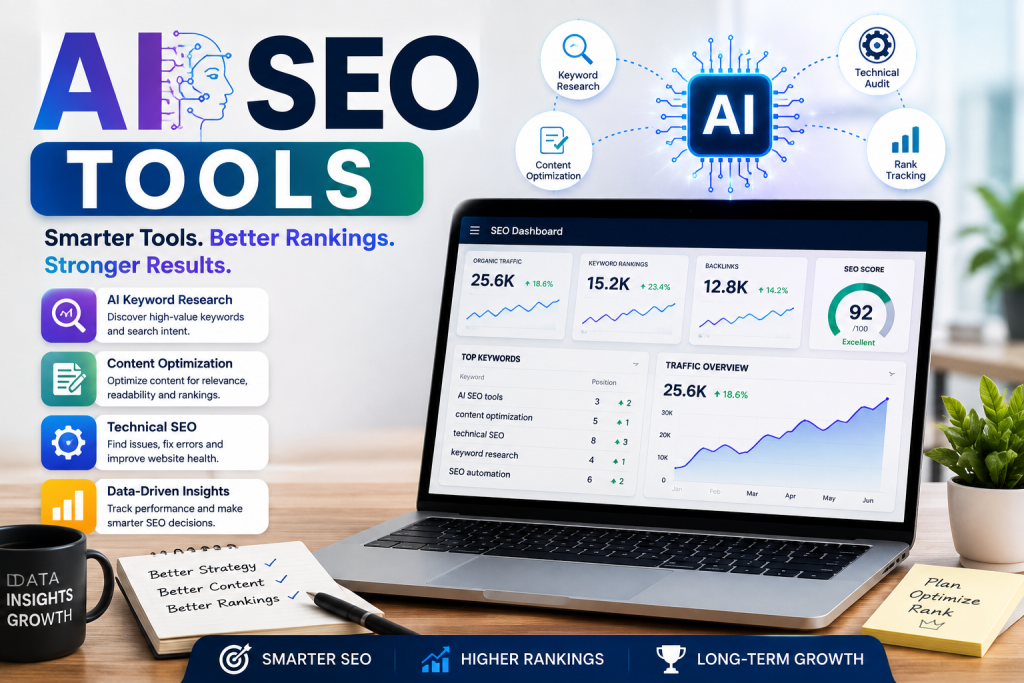
Common Mistakes to Avoid
AI can make SEO faster, but using it incorrectly can create problems.
Avoid publishing large amounts of generic AI-generated content, stuffing keywords unnaturally, copying competitor structures too closely, or creating pages solely to capture search variations.
Google’s guidance warns that generating many pages with AI without adding value can fall under scaled content abuse.
Instead, use AI for research, organization, analysis, brainstorming, and optimization—then add genuine human value.
Final Thoughts
The best AI SEO Tools are not replacements for SEO professionals. They are productivity tools that can help marketers research faster, identify opportunities, improve content, and make better decisions.
In 2026, the winning strategy is not simply “use more AI.” It is to use AI intelligently while maintaining strong SEO fundamentals, original expertise, accuracy, and a people-first approach.
If you combine intelligent automation with high-quality content and a clear understanding of search intent, you can build a stronger, more scalable SEO strategy for long-term organic visibility.
Leave a Reply