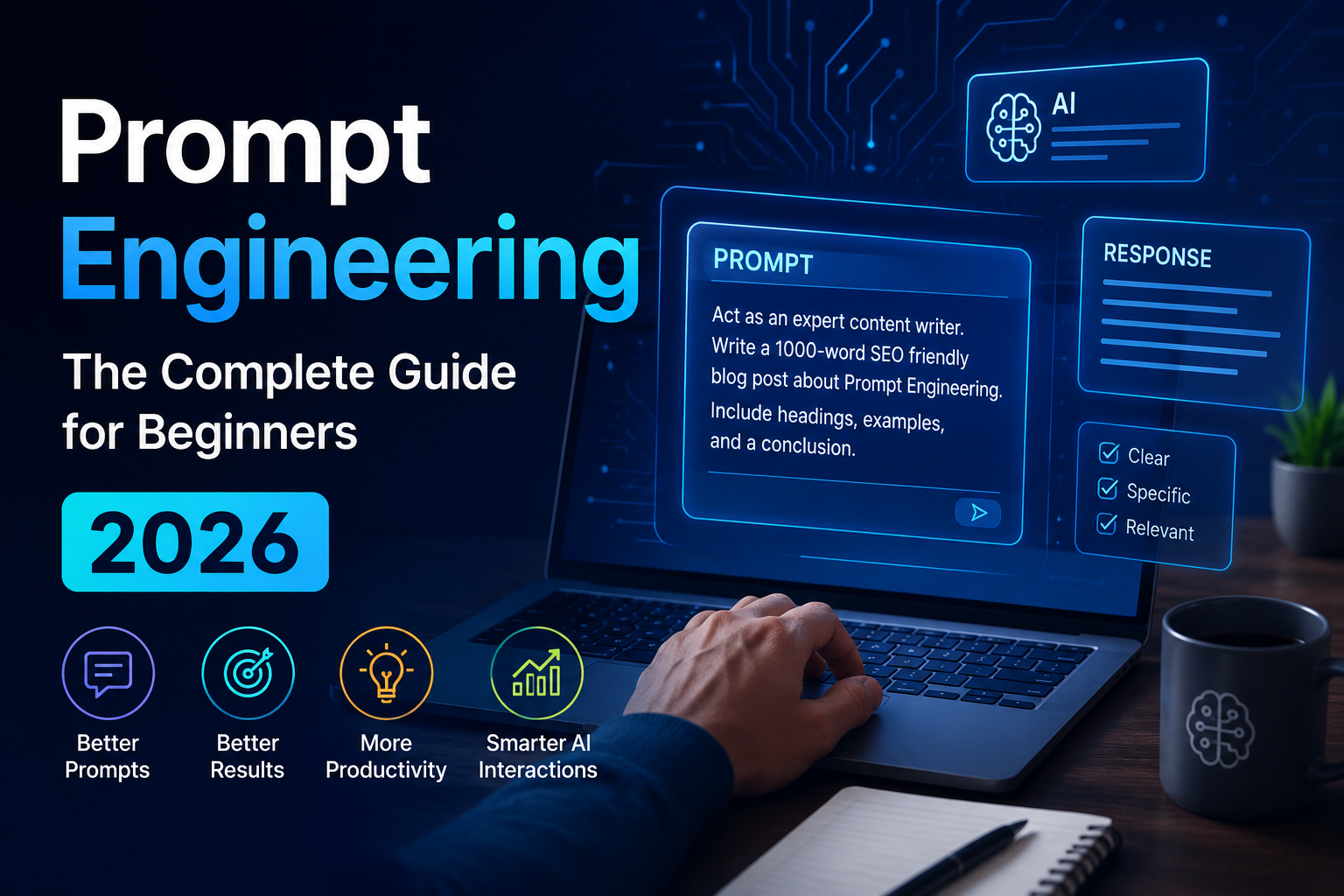
Artificial intelligence is changing the way people write, research, code, design, and solve problems. However, getting high-quality results depends on one important skill: Prompt Engineering.
Whether you’re a student, content creator, marketer, business owner, developer, or freelancer, learning how to communicate effectively with AI can save time and improve productivity. As AI tools continue to evolve in 2026, writing clear prompts has become a valuable digital skill.
This guide explains everything beginners need to know, including what Prompt Engineering is, why it matters, best practices, examples, common mistakes, and future trends.
What Is Prompt Engineering?
Prompt Engineering is the process of writing clear, structured, and detailed instructions that help AI tools generate accurate, useful, and relevant responses.
Instead of asking vague questions, users create prompts that provide context, objectives, formatting requirements, tone, and constraints. Better prompts produce better outputs.
Think of AI as an incredibly knowledgeable assistant. The more specific your instructions are, the better it understands your expectations.
For example:
Weak Prompt
Write an article about fitness.
Better Prompt
Write a 1,000-word beginner-friendly fitness article with SEO optimization, practical tips, headings, and a motivational tone.
The second prompt gives the AI enough information to create a much stronger response.
Why Prompt Engineering Matters in 2026
AI is now used in almost every industry. Professionals rely on AI for writing, coding, customer support, education, research, business planning, marketing, and automation.
Learning this skill helps you:
- Save hours of work
- Improve content quality
- Reduce editing time
- Generate more creative ideas
- Automate repetitive tasks
- Increase workplace productivity
- Create better AI-generated images
- Write higher-quality code
- Produce professional documents faster
Instead of replacing creativity, effective prompting enhances it.
How AI Understands Prompts
AI analyzes the words inside your prompt to understand:
- Your goal
- The topic
- Writing style
- Audience
- Desired format
- Output length
- Context
- Restrictions
If important information is missing, the AI fills the gaps using probability, which may lead to generic or inaccurate responses.
Adding more context usually improves the final output.
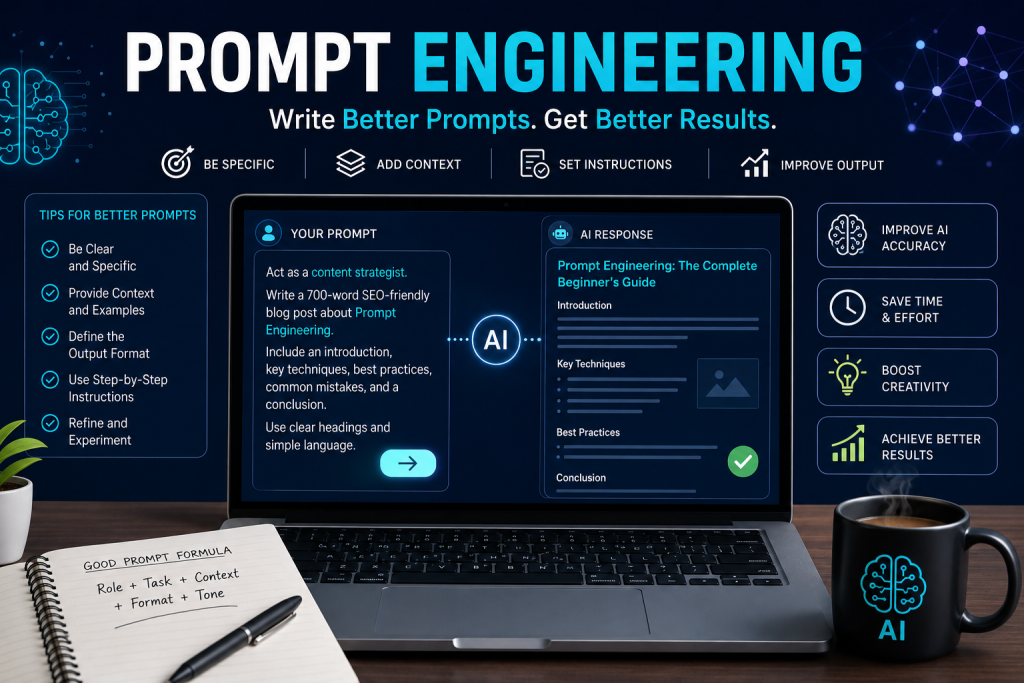
The Five Parts of a Great Prompt
Most successful prompts include these elements.
1. Define the Goal
Clearly explain what you want.
Example:
Write a beginner’s guide about digital marketing.
2. Add Context
Provide background information.
Example:
The article is for beginners with no technical knowledge.
3. Specify the Format
Tell AI exactly how the response should look.
Examples:
- Blog article
- Table
- Bullet list
- Social media post
- Step-by-step guide
4. Mention Tone
Examples include:
- Professional
- Friendly
- Educational
- Conversational
- Formal
- Persuasive
5. Set Requirements
Include important instructions like:
- Word count
- SEO optimization
- Heading structure
- Examples
- FAQs
- Keywords
- Call-to-action
The more complete your prompt is, the more useful the output becomes.
Best Practices for Writing Better Prompts
Follow these proven techniques.
Be Specific
Avoid:
Explain AI.
Instead write:
Explain artificial intelligence for beginners in simple language with real-world examples.
Give Examples
Examples help AI understand exactly what you expect.
For instance:
Use headings similar to professional technology blogs.
Break Large Tasks into Smaller Steps
Instead of requesting everything at once, ask AI to complete one section at a time.
This usually produces higher-quality results.
Assign a Role
Examples:
- Act as an SEO expert.
- Act as a lawyer.
- Act as a software engineer.
- Act as a travel planner.
- Act as a professional teacher.
Role prompting often improves accuracy and consistency.
Ask for Revisions
Don’t settle for the first answer.
Try requests like:
- Make it shorter.
- Add more examples.
- Improve readability.
- Rewrite for beginners.
- Make it more engaging.
Iteration is one of the biggest advantages of working with AI.
Common Prompt Engineering Techniques
Here are several popular methods professionals use.
Zero-Shot Prompting
Simply ask a question without examples.
Example:
Explain blockchain technology.
One-Shot Prompting
Provide one example before asking AI to continue.
Few-Shot Prompting
Provide several examples so AI can mimic the desired style or format.
Chain-of-Thought Prompting
Ask AI to explain reasoning step by step for educational or analytical tasks.
This approach is especially useful for math, logic, planning, and troubleshooting.
Role-Based Prompting
Assign AI a professional identity.
Example:
Act as an experienced financial advisor and explain retirement planning.
Real-Life Applications
People use prompting across many industries.
Content Writing
- Blog posts
- Product descriptions
- Email newsletters
- Website copy
- Social media captions
Marketing
- Advertisement ideas
- Campaign planning
- Keyword research
- Landing pages
Programming
- Debugging
- Code generation
- Documentation
- Learning new programming languages
Education
- Lesson plans
- Study guides
- Quiz creation
- Homework explanations
Business
- Meeting summaries
- Reports
- Business plans
- Customer support replies
Common Mistakes Beginners Make
Many new users struggle because they:
- Write prompts that are too short.
- Forget to mention the target audience.
- Skip formatting instructions.
- Ignore tone requirements.
- Expect perfect results from the first response.
- Fail to provide enough context.
Avoiding these mistakes can dramatically improve AI-generated content.
Tips for Better AI Responses
Use these simple strategies every time.
- Be clear.
- Stay specific.
- Add context.
- Define the audience.
- Mention the desired length.
- Include formatting instructions.
- Request examples.
- Ask for revisions if necessary.
These habits consistently produce stronger results.
Is Prompt Engineering Difficult?
Not at all.
Anyone who can write clear instructions can learn this skill.
The biggest improvement comes from practice.
Over time, you’ll naturally learn which prompts generate better responses and how to refine them for different tasks.
Future of Prompt Engineering
As AI continues advancing, prompting will become an essential workplace skill rather than a specialized one.
Future developments may include:
- More personalized AI assistants
- Smarter multimodal systems
- Voice-based prompting
- Real-time workflow automation
- Better integration with productivity tools
- Improved business automation
- Faster content generation
- More accurate AI collaboration
People who develop strong prompting skills today will be better prepared for tomorrow’s AI-powered workplace.
Frequently Asked Questions
Is Prompt Engineering worth learning?
Yes. It helps users generate higher-quality AI responses while saving time and improving productivity.
Who should learn Prompt Engineering?
Students, marketers, writers, developers, educators, entrepreneurs, researchers, and professionals can all benefit from learning this skill.
Do I need coding knowledge?
No. Most prompting techniques require only clear communication and logical thinking.
Can Prompt Engineering improve SEO content?
Yes. Well-structured prompts can generate articles with better organization, readability, keyword placement, and search engine optimization.
Final Thoughts
Artificial intelligence continues to reshape the way people work, create, and solve problems. Learning Prompt Engineering is one of the smartest investments for anyone who wants to make the most of modern AI tools.
The key is simple: write clear instructions, provide meaningful context, and refine your prompts based on the results. With regular practice, you’ll consistently produce better content, improve productivity, and unlock the full potential of AI in both personal and professional projects.
As AI technology evolves throughout 2026 and beyond, mastering this practical skill will help you stay ahead in an increasingly digital world.